
Quick Answer
In 2026, Nightjar read the public product data of 1,000 Shopify stores picked at random from the 1 million most popular websites: 595,734 products and 3.2 million images. The typical store in the study shows 4 photos per product, and its median main photo is 1,200 pixels on the short side. In the average store, only 17.5% of product photos reach the 2,048 pixels Shopify suggests for square images. 47% of stores have at least one main photo under the 500 x 500 minimum Google Merchant Center enforces from January 31, 2027, though Google says it will optimize some small images itself. Square 1:1 is 60% of main photos, but 31% in clothing stores.
Key findings from 1,000 Shopify stores
These are the headline numbers from the study. Each store counts once, whatever the size of its catalog, so a store with 20 products weighs the same as one with 1,000. "Typical" means the median store; "the average store" means a share worked out inside each store, then averaged across stores.
- Photos per product: the typical store shows 4 photos per product. In the average store, 21% of products have one photo, 48% have five or more and 1% have none.
- Image size: in the typical store, the median main photo is 1,200 pixels on its short side. In the average store, 24% of product photos are under 1,000 pixels on their short side, 60% are under 1,500 and 17.5% reach 2,048 or more.
- Google's 2027 minimum: in the average store, 4% of product photos are under 500 x 500. They are spread thin: 63% of stores have at least one, and 47% have at least one main photo that small.
- Aspect ratio: 60% of main photos are square, and square is the most common main-photo shape in 65% of stores. In clothing stores, 31% are square and most of the rest are portrait (2:3, 3:4 and 4:5).
- Consistency: in 56% of stores, at least 95% of main photos share one aspect ratio. In 28%, fewer than 80% do, so the collection grid shows mixed shapes unless the theme crops them.
- Backgrounds: 40% of main photos sit on white, 16% on off-white or pale grey, 9% are transparent, 3% sit on another plain color and 33% have a scene, a person or another non-plain background.
- Color variants: in stores that sell products in several colors, 85% of color options have a photo linked to them in Shopify.
- Alt text and video: in the average store, 60% of product images have no alt text, and 5% of products have a video.
How many photos do Shopify stores have per product?
The typical Shopify store in this study shows 4 photos per product (the median across the 1,000 stores). Half of the stores sit between 2 and 7 photos per typical product. At the low end, 17% of stores show a single photo for most of their products; at the high end, 15% show 9 or more.
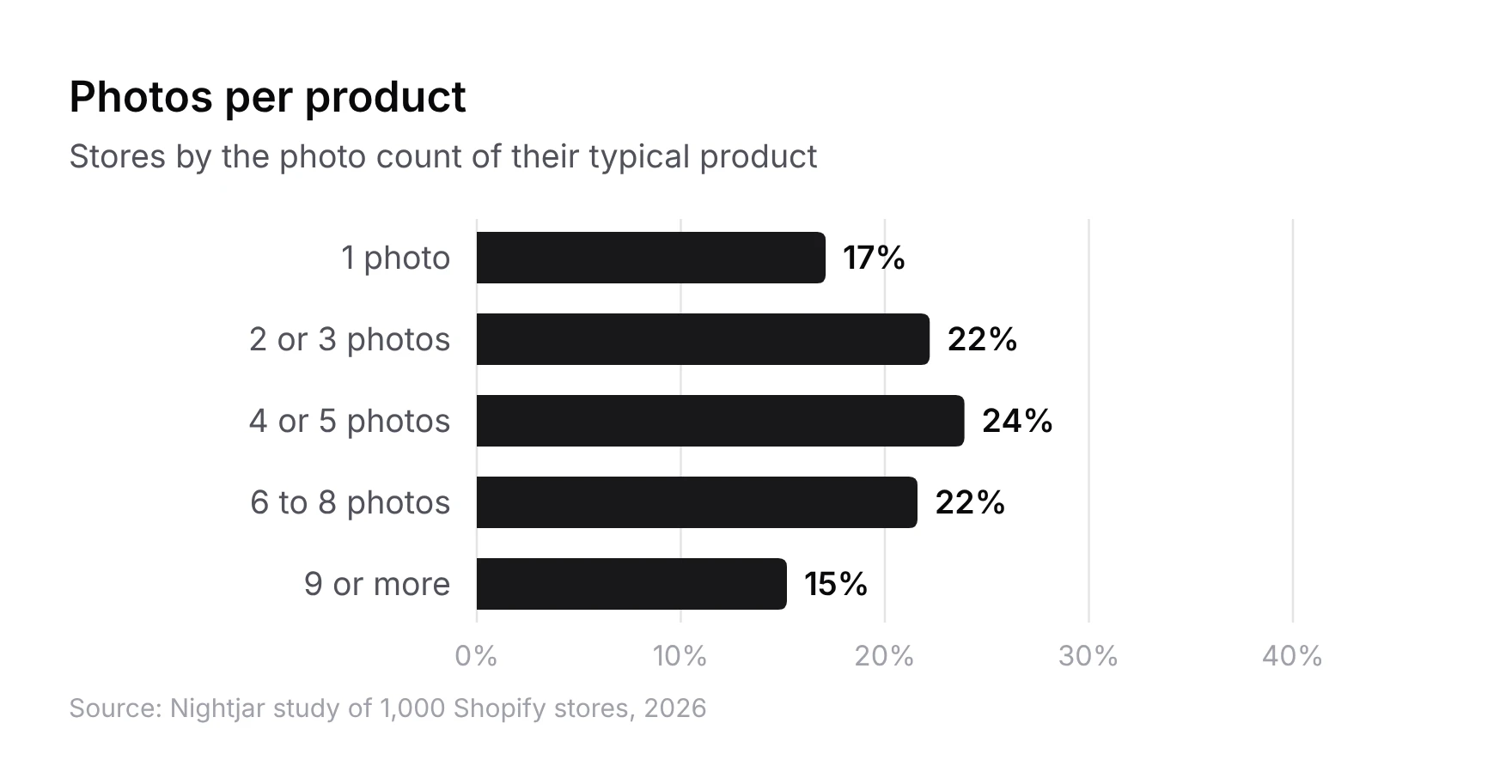
Counted product by product within each store, the average store has 21% of its products on one photo, 48% on five or more and 39% on six or more. Six is what Google's image best practices describe: a main image plus "at least 5+ additional images" (Google Merchant Center). TikTok Shop's quality guide asks for five or more images for its Good tier.
Photo counts depend heavily on what a store sells. Shoe, clothing, home and bag stores photograph the most, at 5 to 6 photos per typical product. Books, prints and food stores photograph the least, often one image per product.
| Store category | Stores | Typical photos per product | Products with one photo | Square main photos | Main photos with a scene, person or other |
|---|---|---|---|---|---|
| All stores | 1,000 | 4 | 21% | 60% | 33% |
| Clothing | 262 | 5 | 8% | 31% | 45% |
| Home and garden | 127 | 5 | 20% | 73% | 43% |
| Beauty and personal care | 84 | 4 | 28% | 77% | 24% |
| Toys, games and hobbies | 64 | 3 | 34% | 61% | 40% |
| Sports, outdoors and auto parts | 62 | 3 | 28% | 70% | 11% |
| Electronics | 60 | 4.5 | 27% | 79% | 11% |
| Jewelry and watches | 54 | 4 | 18% | 64% | 24% |
| Health and supplements | 48 | 4 | 21% | 78% | 9% |
| Books, art and stationery | 41 | 1 | 49% | 51% | 45% |
| Shoes | 39 | 6 | 8% | 66% | 20% |
| Food and drink | 34 | 2.5 | 43% | 69% | 33% |
| Bags and accessories | 31 | 5 | 12% | 65% | 20% |
The percentages are store averages. Rows with fewer than 100 stores are rough guides: a category of 40 stores has a margin of error of about 15 points. Pet and baby stores were too few to show, and 74 mixed or business-supply stores are in the All stores row only.
Newer products tend to get more photos. In the 380 stores with at least five products from both periods, products added in 2025 or 2026 had more photos than products added in 2022 or earlier in 43% of stores, and fewer in 30%. The typical count went from 4 to 5. To plan how many photos your own products need, see how many product photos you need per SKU.
What size are Shopify product images?
In the typical Shopify store in this study, the median main product photo is 1,200 pixels on its short side. That clears the 500 and 600 pixel minimums of Google, Meta and TikTok Shop, and falls short of what Shopify and Google recommend. In the average store, 60% of product photos are under 1,500 pixels on their short side, and 82.5% are under 2,048.
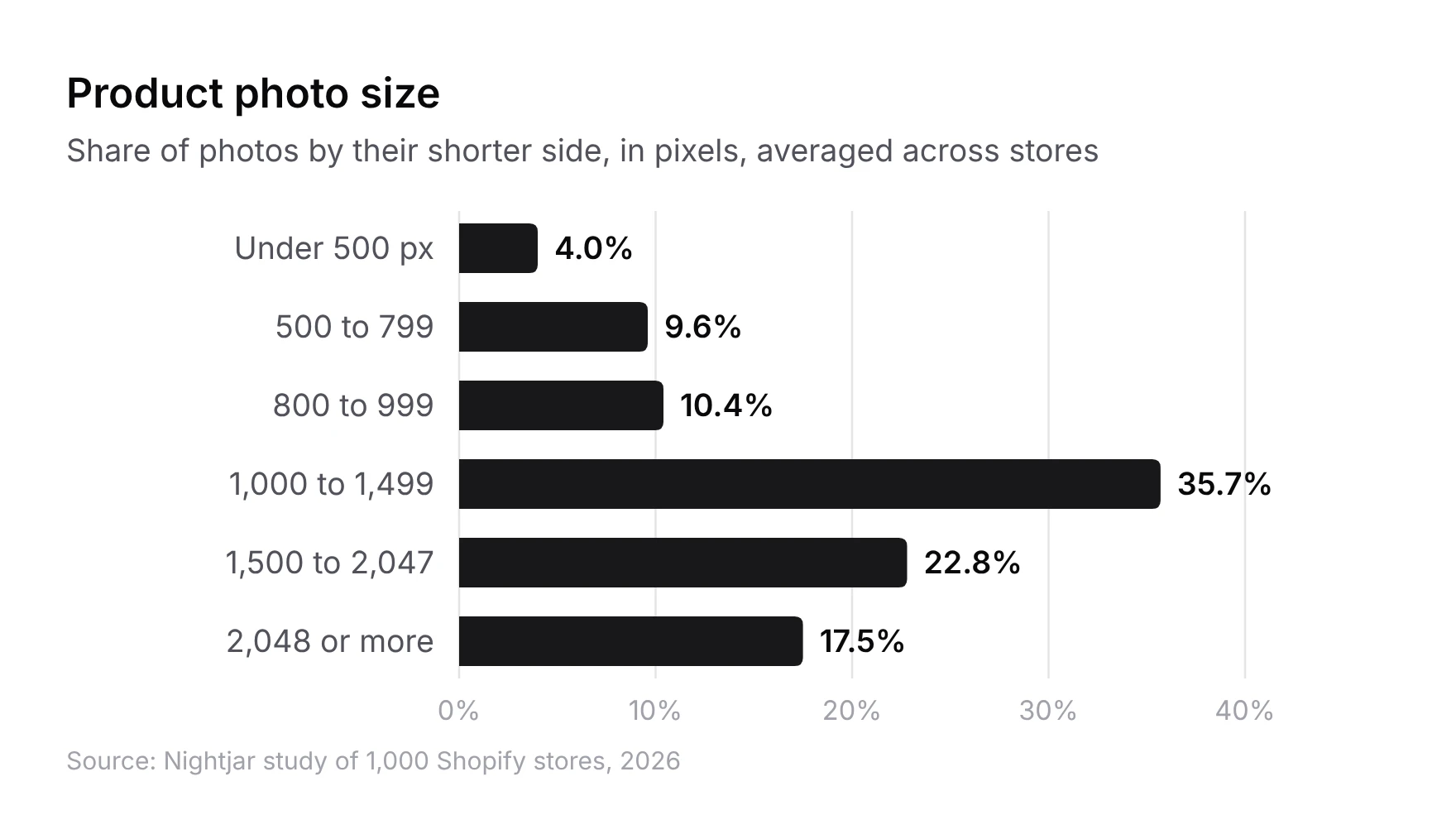
Here is how the same photos measure against the size rules that matter to a Shopify seller, as a share of each store's photos averaged across stores. A photo counts as below a rule when its shorter side is under the minimum, or 800 pixels or less for zoom.
| Rule | Size | Product photos below it | Main photos below it |
|---|---|---|---|
| Google Merchant Center and Meta catalog minimum | 500 x 500 | 4.0% | 4.0% |
| TikTok Shop minimum | 600 x 600 | 6.5% | 6.8% |
| Shopify's zoom guidance | more than 800 x 800 | 18.4% | 18.6% |
| Google's recommended size | 1,500 x 1,500 | 59.7% | 60.6% |
| Shopify's suggestion for square photos | 2,048 x 2,048 | 82.5% | 83.0% |
The 500 x 500 line matters most right now. Google Merchant Center raises its minimum for every product image, main and additional, to 500 x 500 pixels from January 31, 2027, and already warns sellers with the message "Image too small for upcoming enforcement". Google also says it "will also begin optimizing some images that are smaller than 500 x 500" so those products avoid disapproval. It doesn't say which ones, so a seller can't count on it.
Few stores have many of these small photos, but many stores have a few. 63% of stores have at least one product photo under 500 pixels on a side, and 47% have at least one main photo that small. 15% have 5% or more of their main photos that small, and 5% have a quarter or more. For the full Google rules, see Google Shopping image requirements.
Photos got bigger, then stopped. Main photos uploaded from 2017 to 2019 had a median short side of about 950 to 1,000 pixels across stores. For photos uploaded in 2024, 2025 and 2026, it was 1,200 each year.
File format matters less than pixel size. In the average store, 67% of photos were uploaded as JPEG, 22% as PNG and 11% as WebP, but Shopify's image service serves each shopper "the best format available", such as WebP or AVIF, whatever was uploaded. A small photo stays small in every format.
What aspect ratio do Shopify stores use for product photos?
Square 1:1 is the most common shape for Shopify product photos: 60% of main photos are square, and square is the most common main-photo shape in 65% of stores. The rest are mostly portrait. Landscape main photos are rare, about 10%.
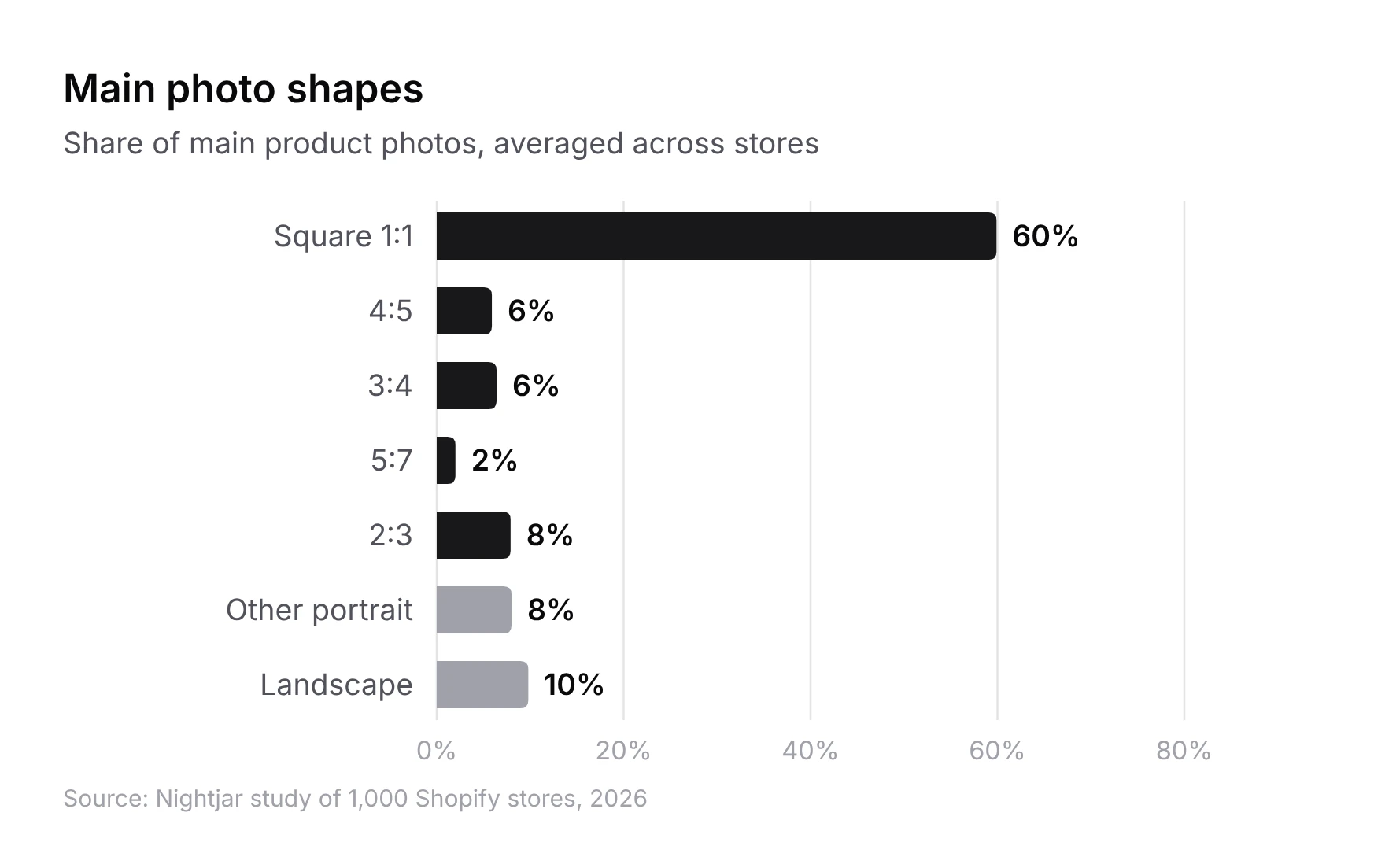
Clothing is the exception. 31% of main photos in clothing stores are square, 23% are 2:3, 17% are 3:4 and 13% are 4:5, since a standing person fits a tall frame. Electronics, health and beauty stores are the most square, at 77% to 79%.
Shopify gives a size for square photos and asks for one consistent aspect ratio, but does not require square. Its help center says "For square product images, a size of 2048 x 2048 px usually displays best" and asks for "a consistent aspect ratio" for main images (Shopify Help Center). What shoppers see depends on the theme. Dawn, a free Shopify theme, is the most common theme in this study, on 13% of stores. Its collection grids default to an Image ratio setting called Adapt to image, which gives each product card the shape of its own main photo. Dawn's other two options, Portrait (4:5) and Square, put every card in the same frame and crop photos to fill it. For the right ratio on each sales channel, see which aspect ratio to use on each ecommerce platform.
How consistent are Shopify stores' product photos?
Most Shopify stores keep their main photos in one shape, but more than a quarter don't. Among the 993 stores with at least five products, 56% have at least 95% of their main photos in exactly the same aspect ratio. 28% have fewer than 80% in one shape. On a collection page, that shows as cards of different heights, or as uneven crops when the theme fits every card to one frame.
Inside a single product, consistency is better. In the average store, 76% of products with two or more photos keep every photo in one shape.
Backgrounds follow the same pattern. In 62% of stores, at least 80% of main photos share one kind of background, such as white or a lifestyle scene. In 30% of stores, main photos mix plain and non-plain backgrounds. In those stores, at least a fifth of main photos sit on a plain light background (white, off-white, pale grey or transparent), and at least a fifth show a scene, a person or another non-plain background. Mixing on purpose can work. Mixing because photos came from different shoots, suppliers and years can make a store look less put together.
Do Shopify stores use white backgrounds or lifestyle photos?
Plain backgrounds lead on Shopify main photos. 40% of main photos sit on white, 16% on off-white or pale grey, 9% are transparent cutouts and 3% sit on another plain color. 33% have a scene, a person or another non-plain background, such as a graphic.
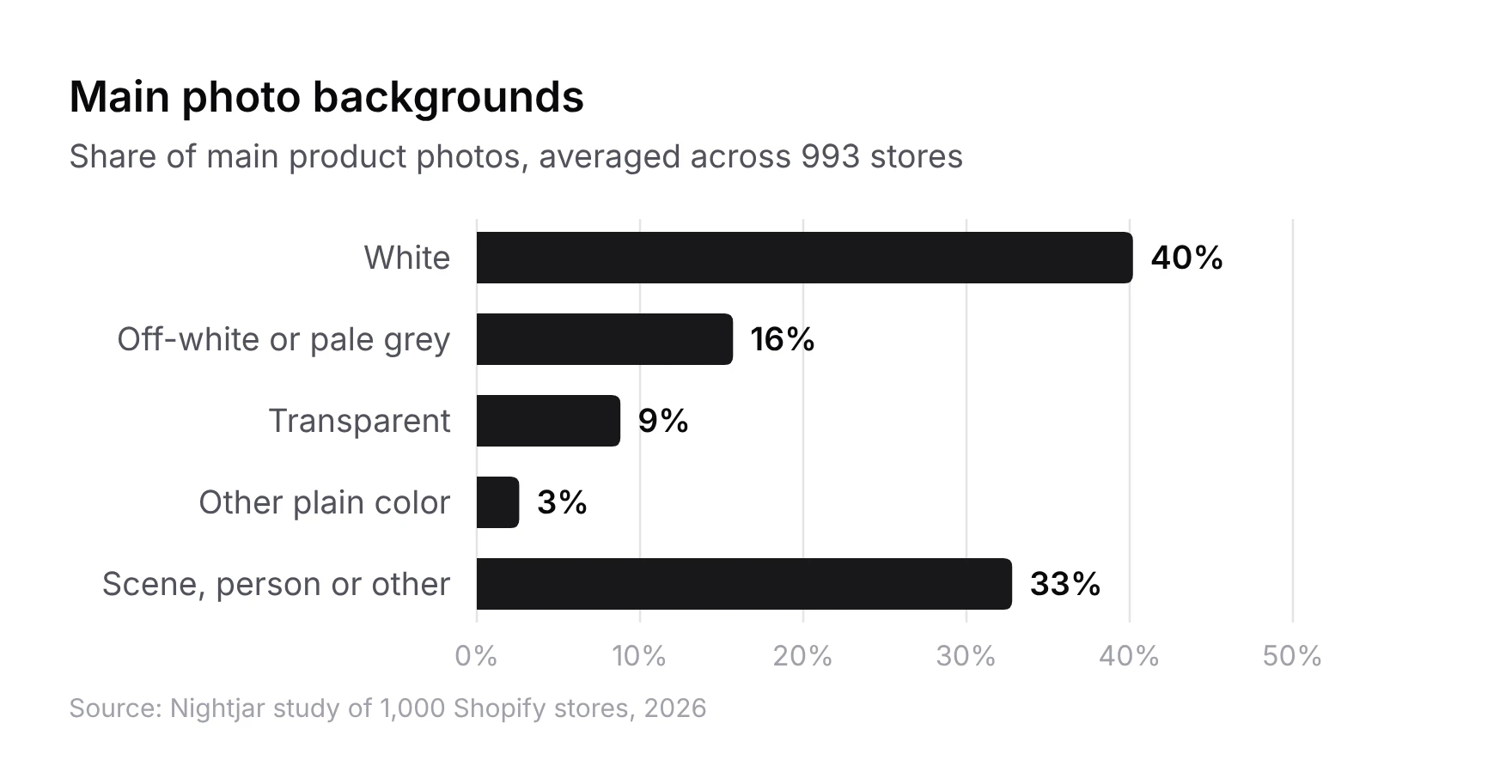
The category decides a lot. Sports and auto parts stores put 76% of main photos on white and electronics stores 66%. Clothing stores use a scene, a person or another non-plain background in 45% of main photos, and off-white or grey in another 28%. Health and supplement stores use transparent cutouts for 37% of main photos, more than any other category. For when each background works best, see lifestyle vs white background product photos.
Do Shopify stores show a photo for every color?
Most Shopify stores that sell several colors link a photo to most of them. In the average store, 46% of products have more than one variant, and 56% of those products link at least one variant to its own photo. In the 420 stores with at least three products that have a color, finish or metal option, 85% of color options have a photo linked to them, and 82% of those products have a linked photo for every color.
That leaves about one color in seven with no photo linked to it. When a shopper picks that color, the main image doesn't switch to it, so the shopper may never see that color. Google asks sellers to "submit a distinct, dedicated image for every individual variant" (Google Merchant Center). Shopify lets you add one image to each variant (Shopify Help Center).
Some stores list each color as its own product instead of as a variant. Those stores aren't counted in these color numbers.
Alt text, video and 3D on Shopify product pages
In the average store in this study, 60% of product images have no alt text set (992 stores, five random products per store). In 43% of stores, none of the sampled images had any. In 23%, every one did. Of the 14,417 alt texts found, the median is 53 characters, 7% repeat the product title exactly and 6% look like file names, such as "IMG_4021".
Missing alt text doesn't always mean an empty alt attribute on the page. On Dawn's demo store, a product with no alt text gets the product title as its alt text on collection cards and in the zoom view, and an empty alt in the main product gallery. To write it well, see how to write alt text for product photos.
Video is uncommon: in the average store, 5% of sampled products have a product video, and 13% of stores showed at least one in their sample. 3D models were almost absent, with one store in the sample.
Product image rules that popular guides get wrong
Most Shopify image guides agree on 2,048 x 2,048 and square. Several repeat details that current Shopify and Google pages contradict:
- 2,048 x 2,048 is a suggestion, not a maximum. Shopify accepts product images up to 5,000 x 5,000 pixels or 25 megapixels, under 20 MB (Shopify Help Center). Shopify's developer docs and its Uploading images page still give 4,472 x 4,472 (20 megapixels).
- Not every theme shows square cards. Dawn's collection grid follows each photo's own shape by default, so uneven photos show as uneven cards.
- A product can hold up to 250 media items (images, videos and 3D models), not thousands (Shopify Help Center).
- Google Merchant Center sets no aspect ratio for product images. It sets a minimum size and recommends about 1,500 x 1,500, while some channels, such as TikTok Shop, ask for square images.
What the numbers mean for your Shopify store
The study points to three common gaps: small photos, mixed shapes and colors with no photo. Each is quick to check in your own store.
- Find your smallest photos. If you sell on Google Shopping, Merchant Center already flags them with the warning "Image too small for upcoming enforcement". Otherwise, open
yourstore.com/products.json?limit=250in a browser (add&page=2for the next 250) and look at each image's width and height. Anything under 500 pixels on a side is already below Meta's catalog minimum and will be below Google's from January 31, 2027. - Upload new photos at 2,048 pixels or more. Shopify suggests 2,048 x 2,048 for square photos, and Google recommends about 1,500 x 1,500. In the average store, 82.5% of product photos are smaller than 2,048 on their short side.
- Pick one shape for main photos. Square is the most common choice in every category but clothing, where most stores use a portrait shape such as 2:3, 3:4 or 4:5. Set the theme to match, or leave Dawn on Adapt to image once every main photo shares one shape.
- Aim for six or more photos on products that sell. Google recommends a main image plus at least five more, TikTok Shop's Good tier asks for five or more, and the typical store shows four.
- Link a photo to every color in Shopify, so the main image changes when a shopper picks one.
- Fill in alt text on main photos first, then the rest of the gallery.
Nightjar covers four of these six steps from the photos you already have. For small photos, Upscale brings any image to 2K (2,048 pixels on the long edge) or 4K without changing the product. 2K gives a square photo 2,048 x 2,048, and portrait photos need 4K to reach 2,048 on their short side. For mixed shapes, a Recipe saves the aspect ratio, resolution, background and look, so every new product starts from the same setup. For one-photo products, a Photoshoot turns one product into four matching images, and for missing colors, Recolor changes a product to any color while keeping its lighting, shadows and texture. In the Nightjar Shopify app, products come straight from your store, and you can try it on one product with 6 free Credits and no card.
How this compares with earlier research
We found no earlier published study of photos per product, pixel sizes or aspect ratios across Shopify stores. Earlier work looked at narrower questions:
- Image resolution: Baymard Institute's 2020 benchmark found product images with too low a resolution on 14% of the ecommerce sites it reviewed (Baymard Institute).
- Alt text across the web: the WebAIM Million found missing alt text on 53.1% of home pages in 2026, across all kinds of sites (WebAIM). This study finds 60% of Shopify product images with no alt text set.
- Alt attributes on Shopify pages: a 2026 Batchset analysis of one product page on each of 199 Shopify stores found a first-loaded image with no alt attribute on 19.5% of pages (Batchset). That is far below this study's 60%, likely because themes such as Dawn fill in the product title when the alt field is empty.
How the study was done
The study covers 1,000 Shopify stores, read in 2026 from public data only, with no logins and no paid data. No store is named.
- Picking the stores. We took the Tranco list of the 1 million most popular websites (list N26LW), put it in random order and checked every domain's DNS. About 31,100 pointed to Shopify's storefront network. We visited them in random order and kept each store whose public product list worked, until we had 1,000. 1,027 domains were visited to get there, and the same store under two domains counted once. The typical store ranks around 635,000th on the list. Most Shopify stores don't rank in the top million, so these are established stores with real traffic, mostly not the biggest brands.
- Visiting politely. Each store got one request at a time, at least a second apart, from a crawler that names itself and links to Nightjar.
- Reading the products. For each store we read Shopify's public product list (
/products.json), which gives every image's pixel size, position and variant links, for up to the 1,000 most recently published products. Gift cards and checkout add-ons, such as shipping protection and donations, were left out because their images are icons. - Shapes. A photo counts as a named ratio, such as 4:5, when it is within 1.5% of it. For consistency, two photos share a shape when their width divided by height matches to two decimals.
- Backgrounds. We checked the main photo of up to 20 random products per store (19,698 photos) by the color of a thin ring of pixels at the photo's edge. White means at least 85% of edge pixels are 245 or brighter on every color channel. "Scene, person or other" covers anything that isn't a plain background, including graphics and products that touch the frame's edge. We checked the results visually on contact sheets.
- Alt text, video and themes. Alt text and video come from five random products per store, read from each product's public data. Themes come from each store's public home page, which named its theme on 967 stores.
- Categories. Each store got one category from its product types and product titles, labelled with AI help and spot-checked by hand.
- Counting. Every share is worked out inside each store, then averaged across stores, so every store counts once. "Typical" means the median store. With 1,000 stores, a store-level percentage has a margin of error of about 3 points either way. Percentages are rounded, so some groups add up to 99% or 101%.
Limits. 37% of stores have 1,000 or more products, so their numbers describe their newest 1,000. Pixel sizes are the uploaded originals; the theme decides the size shoppers see. The DNS check finds stores served from Shopify's own network, so headless stores and stores behind another proxy are missed. Products sold only outside the online store, and stores that block their product list, aren't included.
The anonymized per-store data, one row per store with no names, is free to use with a link to this page: download the CSV.
Frequently asked questions
What size should Shopify product images be in 2026? Upload product photos at 2,048 x 2,048 pixels for square images, the size Shopify says usually displays best. Shopify accepts up to 5,000 x 5,000 pixels, and Google Merchant Center needs at least 500 x 500 from January 31, 2027. In this study, the typical store's median main photo was 1,200 pixels on its short side.
Should Shopify product images be square? Square is the most common choice: 60% of main photos in this study were 1:1. Shopify doesn't require it, and clothing stores mostly use portrait shapes such as 2:3, 3:4 and 4:5. Whatever you pick, use the same shape for every main photo.
How many photos do Shopify stores show per product? The typical Shopify store in this study shows 4 photos per product, and 17% of stores show a single photo for most of their products. Shoe stores show the most, at 6 per typical product. To plan how many your own products need, see how many product photos you need per SKU.
Do Shopify product images need a white background? No. Shopify has no background rule, and 33% of main photos in this study had a scene, a person or another non-plain background. White or off-white backgrounds are the most common, at 56% of main photos, and channels such as TikTok Shop require pure white main images.
References
- Nightjar - AI product photography system
- Tranco list - Ranking of the most popular websites used to pick the stores
- Google Merchant Center: Product data specification update 2026 - 500 x 500 minimum from January 31, 2027
- Google Merchant Center: Image link - Recommended size and one image per variant
- Google Merchant Center: Image best practices - Additional image guidance
- Shopify Help Center: Product media types - Size limits, 2,048 x 2,048 and consistent aspect ratio
- Shopify Help Center: Adding product media - 250 media items per product
- Shopify Help Center: Variant images - One image per variant
- Shopify: Website image size guidelines - Zoom guidance
- Meta: Catalog fields - 500 x 500 catalog image minimum
- TikTok Shop: Product listing policy - 600 x 600 minimum and white main image
- Shopify Dawn theme source - Collection grid image ratio settings
- Baymard Institute: Image resolution and zoom - Share of sites with low-resolution product images
- WebAIM Million - Missing alt text on home pages
- Batchset: Shopify product images in 2026 - Alt attributes on 199 Shopify product pages