
Nightjar LogoSign in
AI Product Photography for Fitness, Gym, and Athleisure Brands

Quick Answer

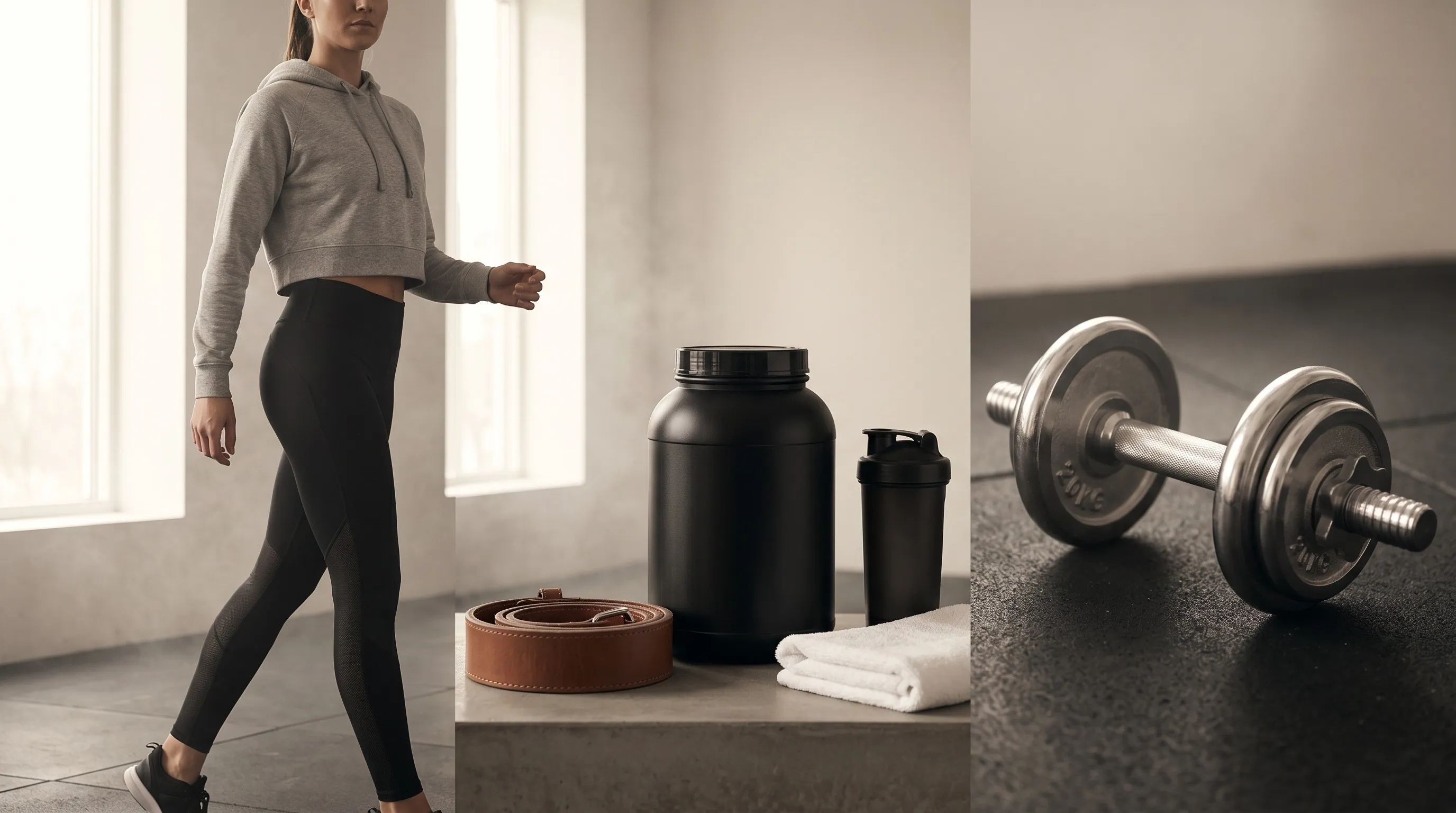
AI product photography for fitness brands works when it is structured around the four physically distinct SKU types most fitness catalogs ship: on-athlete apparel, studio packshots, supplements, and gym equipment. The cleanest approach is to define one brand-level Photography Style and save four reusable Nightjar Recipes (On-Athlete Apparel, Studio Packshot, Supplement Tabletop, Equipment Hero), so a $128 pair of leggings, a $40 protein tub, and a 20kg dumbbell look like they came from the same brand. Supplements have an additional regulatory layer: DSHEA, 21 CFR 101.93, and cGMP rules require label content and the structure/function-claim disclaimer to stay intact, which means AI should generate the surrounding scene while the real labeled bottle stays anchored as the source product Asset.

TL;DR

  • Fitness DTC catalogs ship across four physically different SKU types under one logo: apparel, supplements, gym accessories, and equipment.
  • Each archetype has its own production playbook, but a single brand-level Photography Style can travel across all four.
  • The four Recipes that scale across hundreds of SKUs are On-Athlete Apparel, Studio Packshot, Supplement Tabletop, and Equipment Hero.
  • Performance fabrics (mesh, compression, four-way stretch, flatlock seams) and athletic body proportion continuity across colorways are the two production failure modes generic AI tools hit hardest.
  • Supplements sit inside DSHEA, 21 CFR 101.93, cGMP, and FTC endorsement rules that imagery has to respect; pet brands have the AAFCO conversation, supplements deserve the same DSHEA conversation.
  • Traditional production for a 60-SKU activewear drop with a supplement subline runs roughly $29,500 to $69,000 per drop, before retouching markups; annualized that is $118,000 to $276,000 for a four-drop year.
  • Nightjar is one strong fit when the priority is athletic-fit Fashion Model continuity across colorways, supplement-label preservation, and a Team Library that keeps the visual system shared.
  • The Recipe count stays at four whether the brand has 30 SKUs or 300.

Why fitness brands break generic AI photography

AI product photography for fitness brands is not a single workflow problem. The fitness DTC operator sits at the intersection of three growth categories that almost never share a production system. Activewear is a $456 billion global market in 2026 (Straits Research). Athleisure runs $415 billion in 2026, projected to $647 billion by 2031 (Mordor Intelligence), at a 9.1% US CAGR through 2033 (Grand View Research). Sports nutrition is a $63 billion market in 2026 (Precedence Research).

The brand benchmarks at the top of the category increasingly operate across all three at once. Lululemon FY2025 sits at $10.75 billion (+9.4% YoY) (Retail TouchPoints). Gymshark is approaching $1 billion at $807 million FY2024 (Business of Fashion). Vuori is expanding to 100 stores by 2026 (Spatial.ai), and Alo Yoga peak sales surged roughly 88% YoY in 2024 (Retail Dive).

Fitness DTC catalogs are unusual because most brands ship four physically distinct SKU types under one logo: athletic apparel, supplements, gym accessories, and equipment. Each has a separate production playbook, but a single brand-level Photography Style can travel across all four when the brand operates on a reusable Recipe system instead of a one-off prompt. Generic AI photography content treats each SKU type as a separate problem and never unifies them.

The dollar context tells the rest of the story. A single shoot day for activewear runs $2,500 to $8,000 (BusinessDojo). Model day rates run $800 to $3,000 through agencies. Supplements add a separate tabletop session. Equipment adds a third. None of those are the same shoot, none use the same crew, and none produce images that match each other on the collection grid without an explicit operating system. For a $128 Lululemon Define jacket competing against a $22 Costco Kirkland dupe in a live trade-dress lawsuit (IPWatchdog, Suffolk JHTL), brand visual coherence is a defensible asset, not a luxury.

For broader context, see our broader ecommerce checklist and the real cost of product photography.

The four-Recipe brand system for fitness catalogs

The structural answer is one brand-level Photography Style plus four Recipes. The Recipe count stays at four whether the brand has 30 SKUs or 300. Add a 200th SKU and the Recipe count is still four.

In Nightjar, the photographic look (lighting, camera language, mood, color, atmosphere) is saved as a reusable Photography Style. Nightjar has a feature called Photography Styles, which capture those visual properties from a reference photo and reuse them across Generations. The first time a user picks one, it works as a starting point; once a custom Style holds up, it can be saved and reused across the catalog. The Photography Style is the brand-level anchor, and you can build it from one strong reference photo that already represents how the brand wants to look.

Nightjar has a feature called Recipes, which save the full Create-form setup so the next SKU does not need to be re-briefed. A Recipe captures the Photography Style, the Composition, the Fashion Model, the Background, the Custom Directions, and the output settings. Each of the four sub-vertical Recipes inherits the brand Style and swaps Composition and Background per SKU type. This is the same pattern documented in the parallel guide for pet brands, and it ports cleanly to a category that ships across apparel, supplements, and equipment.

Why this matters at catalog scale. A 60-SKU activewear catalog with five images per SKU is 300 images per refresh. Traditional flat-lay alone runs $50 to $75 per image (Squareshot). On-model is $130 to $500 per outfit (BusinessDojo, Squareshot 2026). Effective cost is two to three times the quoted rate after retouching, studio time, and coordination (ProShot Media). A 500-SKU brand can spend $125,000 to $250,000 per year on traditional photography.

Sub-verticalProduction painRecipe namePrimary Nightjar feature
On-athlete apparelAthletic-fit model continuity across colorways; in-gym scene cohesionOn-Athlete ApparelEdit tab @image1/@image2/@image3 references, custom Fashion Models, Recolor with /color
Studio packshots and ghost mannequinPerformance-fabric rendering (mesh, compression, flatlock seams); white background specStudio PackshotProduct Listing Image Workflow, source Asset preservation, Composition library
Supplements (protein, pre-workout, BCAA)DSHEA disclaimer integrity, cGMP label-content rules, FTC endorsement riskSupplement TabletopProduct Asset preservation, Custom Directions forbidding label text alteration
Gym equipment (dumbbells, kettlebells, racks, bands)Scale, finish realism (rubber, urethane, chrome, iron), 45-degree angle conventionEquipment HeroBackgrounds (image-based scenes), brand Photography Style, Edit tab multi-image for human-scale reference

For the consistency thesis behind this pattern, see the Photography Style explainer and how to maintain a consistent aesthetic across the catalog.

Sub-vertical playbook 1, on-athlete apparel

The production problem

Performance activewear fabrics are technically distinct from generic apparel cotton: polyester-spandex blends, nylon-spandex blends, four-way stretch knits, perforated mesh panels, and compression knits (Spandex By Yard, tasc Performance). The seven visual properties an AI image generator must reproduce credibly are compression-fit drape, mesh perforation, ribbing and flatlock seams, reflective trim, moisture and sweat realism, four-way stretch behavior, and texture differentiation across fabrics.

The diagnostic test is concrete: zoom into a generated AI legging at 200% and check whether the seam between waistband and panel is crisp or melted. Generic AI tools smooth mesh into flat color, render compression as latex sheen, and lose flatlock stitching. That is what makes a generated image read as cosplay rather than catalog.

The deeper problem is identity continuity. A 60-SKU activewear catalog typically launches with 8 to 15 colorways per silhouette. A new prompt is a new person. The same model has to wear all 12 leggings colorways and the matching crop hoodie. Generic prompt-only tools cannot keep the same athlete identity across 12 Generations, let alone 12 colorways across three silhouettes.

According to McKinsey, 70% of fashion returns are sizing-related, with apparel ecommerce return rates near 25% versus 20% across all ecommerce (Bold Metrics). Sportswear specifically runs 20-25% return rates, with leggings, compression shirts, and sports bras among the most-returned items (Rocket Returns). Visual accuracy in the listing image is one of the inputs to that return rate.

Casting matters too. 67% of US women wear size 14 or larger (Wenyuan Clothing), but historical activewear marketing has skewed toward visible-abs lean-fit talent. Inclusive activewear brands (Universal Standard, Girlfriend Collective, Beyond Yoga) explicitly cast across sizes 00 to 40 (The Zoe Report). Modern AI body-type tooling can differentiate "petite fit," "broad athletic fit," and "curvy athletic" as discrete archetypes (Glance AI).

There is one more consideration. MIT research on AI face perception shows that highly realistic or clearly stylized outputs raise fewer concerns than faces in the uncanny valley (MIT DSpace). For activewear, identity stability across the catalog matters more than absolute photographic quality of any single image. A consistent athletic person across 40 SKUs reads as a brand. A drifting person across the same 40 SKUs reads as stock-photo soup.

Nightjar features that map

Nightjar has a feature called Fashion Models: a roster of 80+ pre-built AI people spanning age ranges and gender presentations, plus the option to build a custom Fashion Model from one to five reference Assets. For activewear, a brand can build one female and one male athletic-fit Fashion Model once and reuse the same identity across every colorway, every silhouette, every drop. For a deeper guide to AI fashion model tools, see our cross-tool comparison; for the casting controls themselves, see how to control athletic-fit body type and controlling Fashion Model attributes for diverse casting.

The Edit tab supports multi-image references for the apparel-on-athlete shot. Place the legging from @image1 on the Fashion Model from @image2, in the gym Background from @image3, and output at /ratio 4:5 for Instagram. Recolor with the /color #HEX command generates the full colorway grid from one approved hero, with shadows, folds, fabric texture, and material properties preserved. For the catalog economics of this, see how AI color variants replace reshoots.

A Composition is how Nightjar saves pose, framing, angle, crop, and product placement separately from style. A "front-facing leggings, mid-thigh crop" Composition saved once travels across every leggings drop, so a new colorway reuses the same camera language without rebuilding the brief.

How Nightjar handles this Recipe

Workflow:

  1. Build (or pick) a custom athletic-fit Fashion Model once from one to five brand-aligned reference Assets.
  2. Upload the legging product photo as the source Asset.
  3. Upload or pick a gym Background scene Asset (morning gym light from a window, polished concrete floor).
  4. Apply the brand Photography Style.
  5. In the Edit tab: "Place the legging from @image1 on the Fashion Model from @image2, in the gym Background from @image3, soft morning light, /ratio 4:5".
  6. Save the setup as the On-Athlete Apparel Recipe.
  7. For colorways, re-run the Recipe with /color #HEX per variant.

For the related testing question, see virtual try-on context for activewear sample testing. Nightjar Fashion Models are reusable image-generation ingredients, not size-recommendation or fit-prediction avatars.

Sub-vertical playbook 2, studio packshot and ghost mannequin

The production problem

Apparel flat-lay and standard retouching runs $50 to $75 per image (Squareshot). Ghost mannequin runs $150 to $300 per image (BusinessDojo). The marketplace specs are explicit: Amazon main images need pure white (RGB 255,255,255) backgrounds, the product fills 85% of the frame, the minimum is 1,000 pixels on the longest side, and 1,600 pixels or more is recommended for zoom (Seller Labs). Shopify recommends 2048x2048 square for activewear (Squareshot Shopify 2026).

The performance-fabric rendering risk applies hardest at this stage. At 200% zoom on the marketplace listing, a smoothed mesh panel or a melted flatlock seam will break the listing. The buyer is inspecting fabric structure on the PDP. Ghost mannequin (the real garment hollowed out for the inside-collar shot) is one of the production tasks AI handles cleanly when the source garment Asset is preserved.

Nightjar features that map

The Product Listing Image Workflow is Nightjar's core Workflow for ecommerce-ready product imagery. Use it with a tabletop or hanging-garment Composition, white Background, 2048x2048 default output, and JPEG or WebP. Source Asset preservation keeps the actual legging or hoodie anchored through Generation, so mesh perforation and flatlock seams remain intact.

Custom Directions in Nightjar are user-written instructions layered on top of the structured controls. Use them to preserve technical detail explicitly: "preserve flatlock seams visible at hip and inner thigh; mesh panel at calf must show perforation; do not smooth fabric texture." Upscale brings an existing Asset to 2K or 4K long-edge while preserving the product, which is useful for marketplace zoom and high-DPI storefronts.

How Nightjar handles this Recipe

Workflow:

  1. Upload the legging or hoodie product photo as the source Asset.
  2. Apply the brand Photography Style.
  3. Apply a packshot Composition (flat-lay or ghost-mannequin).
  4. Select white Background, 2048x2048 output, JPEG or WebP.
  5. In Custom Directions: "preserve flatlock seam visibility at hip and inner thigh; mesh panel at calf must show clear perforation; do not smooth fabric texture."
  6. Save as the Studio Packshot Recipe.

For AI virtual model vs ghost mannequin guidance, see the deeper comparison. For the framing layer, see how Compositions actually work in practice.

Sub-vertical playbook 3, supplement tabletop and the DSHEA rules every supplement brand should know

The production problem

Sports nutrition is a $63 billion market in 2026 (Precedence Research). Pre-workout alone is $21.7 billion in 2025 (Future Market Insights). Protein supplements are $31.86 billion in 2026 (Grand View Research). Supplement tabletop traditional production runs $50 to $100 per image on white background, $100 to $200 with props (Razor Creative Labs).

The brand benchmarks tell the operating story. Optimum Nutrition (Glanbia, Gold Standard whey) sits at the legacy end. Ghost positions itself as the "first lifestyle sports nutrition brand" (Ghost Lifestyle). Transparent Labs leans on a clean-label "100% formula transparency" pitch (Transparent Labs). What ties them together is a unique imagery constraint: the label is the regulatory primary surface. AI cannot regenerate label content without breaking compliance.

The DSHEA, 21 CFR 101.93, cGMP, and FTC imagery rules every supplement brand should know

The regulatory rule, in one place:

The Dietary Supplement Health and Education Act (DSHEA) of 1994 sets the framework. When a supplement makes a structure/function claim ("supports muscle recovery," "promotes endurance"), the disclaimer is mandatory: "This statement has not been evaluated by the Food and Drug Administration. This product is not intended to diagnose, treat, cure, or prevent any disease." (FDA Q&A on Dietary Supplements). 21 CFR 101.93(d) requires that disclaimer to appear adjacent to the claim it modifies, in boldface, in type no smaller than 1/16 inch. On December 11, 2025, FDA issued a letter indicating it will exercise enforcement discretion on the requirement that the disclaimer appear on every label panel containing a structure/function claim, provided the disclaimer is on the label and clearly linked to each claim (NutraIngredients, Hogan Lovells). The substantive disclaimer requirement remains. Separately, 21 CFR Part 111 (cGMP) requires that a supplement contain what its label says, and that packaging and labeling match the master manufacturing record. FTC endorsement guides (16 CFR Part 255) require endorsers to have actually used the product, with civil penalties up to $51,744 per violation for synthetic-endorsement misuse (FTC Endorsements, FTC 2025 changes summary).

Translated to AI imagery: AI may generate the surrounding scene (tabletop, lifestyle, ingredient props that match the actual formula). AI must not regenerate the Supplement Facts panel, ingredient list, or DSHEA disclaimer text. AI must not invent ingredient pictures the product does not contain (a tub on a backdrop of açai berries when the product contains no açai is misleading). AI must not imply disease treatment, prevention, cure, or diagnosis. And AI must not generate an athlete or expert persona "endorsing" the product, because synthetic endorsements made by AI-generated personas fall under the same FTC endorsement rules and carry the same civil penalty exposure.

The synthetic-athlete and FTC endorsement note deserves a self-contained treatment. Brands cannot use AI to generate a "named athlete" or a "doctor persona" endorsing a supplement. The FTC 2023 endorsement guide updates explicitly cover synthetic endorsements: an endorsement made by an AI-generated persona is treated as a substantive endorsement and must be transparently identified. Civil penalties run up to $51,744 per violation. The clean operational path is to anchor the real labeled bottle as the source product Asset and let AI generate only the surrounding scene.

Nightjar features that map

Nightjar is built to keep product shape, text, labels, logos, and packaging anchored. The bottle stays the bottle, the Supplement Facts panel stays legible, and the disclaimer stays in place. The Product Listing Image Workflow handles tabletop scenes with controlled Backgrounds and Photography Styles, with the source Asset preserved. Custom Directions accept regulatory framing directly: "wooden tabletop, gym towel, no extraneous food props, do not alter label text, do not generate açai or fruit ingredient props."

For Amazon supplement compliance specifically, Nightjar's 2048x2048 default exceeds Amazon's 1,600px+ zoom recommendation, and source-Asset preservation keeps the labeled bottle's Supplement Facts panel anchored through Generation, so the ingredient claim and the visible image stay synchronized (Inventory Ready Amazon Supplement Compliance, My Amazon Guy).

How Nightjar handles this Recipe

Workflow:

  1. Upload the labeled supplement bottle (or tub) as the source product Asset.
  2. Apply the brand Photography Style.
  3. Apply a tabletop Composition with a Background that matches the brand's lifestyle world (gym bag, lifting belt, towel) without inventing ingredient props.
  4. In Custom Directions, explicitly forbid altering label text or generating ingredient props the product does not contain.
  5. Do not generate a Fashion Model "holding" or "endorsing" the supplement as an athlete persona.
  6. Save as the Supplement Tabletop Recipe.

For preventing product distortion on regulated SKUs, see the help-desk article. For the parallel discussion of regulated imagery for skincare brands, see the sibling vertical. The DSHEA conversation here mirrors how the pet-brand article handled AAFCO: a real regulatory layer that imagery has to respect, and that competing AI tools never address.

Sub-vertical playbook 4, gym equipment hero

The production problem

Equipment imagery has four distinct production demands: scale, weight, finish realism, and ambient lighting. Industry photographers are explicit about the craft principles. Avoid flat lighting that makes rubber dumbbells appear plastic. Avoid direct flash. Shoot from a 45-degree angle for depth, or waist-height for a more imposing, durable look. Use a human reference for scale: where do the knees hit, where do the hands grip. Differentiate finishes (rubber, urethane, chrome, iron) so the buyer can see what they are actually buying (Shotbg, gxmmat).

The brand benchmarks set the bar. Rogue Fitness (Columbus, OH; CrossFit Games sponsor) leans on dark-background hero shots and consistent 3/4 angles (Rogue Fitness). Eleiko (Swedish, founded 1957) splits the visual system: high-key studio for product, gritty gym lifestyle for editorial; 285K Instagram followers tracks how that split travels (Eleiko). REP Fitness, Bells of Steel, and PowerBlock fill the home-gym lifestyle layer (PowerBlock).

Nightjar features that map

A Background in Nightjar is a solid color or an image-based scene reference. For equipment, the image-based Backgrounds carry "home gym in soft window light" or "concrete-floor strength studio." The same brand Photography Style used for apparel travels here, so a kettlebell shot reads as the same brand as a leggings shot. Lighting consistency across the equipment line is what makes the catalog cohere.

A Composition handles the 45-degree-or-waist-height standard. Source Asset preservation keeps the chrome, urethane, and iron finishes from rendering as a generic shape. The Edit tab supports multi-image composition for human-scale reference: place the kettlebell from @image1 next to the Fashion Model from @image2, in the home-gym Background from @image3, and output at /ratio 4:5. Prompt-only tools cannot express that combination.

How Nightjar handles this Recipe

Workflow:

  1. Upload the equipment photo (dumbbell, kettlebell, resistance band, rack) as the source product Asset.
  2. Apply the brand Photography Style.
  3. Apply a 45-degree or waist-height Composition.
  4. Pick a Background scene Asset (home gym, dark concrete-floor strength studio, garage gym).
  5. In Custom Directions: "preserve knurl texture on grip; matte rubber, no plastic sheen; 45-degree downward angle from camera height of approximately five feet."
  6. Where human-scale reference is needed, use the Edit tab to combine product Asset, Fashion Model, and Background.
  7. Save as the Equipment Hero Recipe.

For the parallel guide for gym equipment material rendering, see the electronics-gadgets sibling on chrome, rubber, and finish realism.

The catalog math, 60-SKU activewear drop with a supplement subline

The dollar-driven question is whether this is worth doing. A worked example with sourced numbers makes the answer concrete.

Take a 60-SKU activewear drop with five images per SKU, which is 300 images per refresh. Traditional flat-lay or standard apparel runs $50 to $75 per image (Squareshot), so flat-lay alone is $15,000 to $22,500. Add on-model at $150 to $300 per look, plus a $500 to $2,000 model day rate, plus studio and retouching, and the realistic line for the apparel drop is $25,000 to $60,000. Add a supplement subline of 10 SKUs with four tabletop images each at $50 to $100 per image, and that is $2,000 to $4,000. Add an equipment line of 5 SKUs with five hero or scene images each at $100 to $200 per image, and that is another $2,500 to $5,000.

The total seasonal drop range is $29,500 to $69,000 before assistants, transport, sample logistics, and the two-to-three-times effective-cost multiplier ProShot Media documents. For a brand running four seasonal drops a year, annualized photography spend lands at $118,000 to $276,000, or $264,000 to $828,000 with the effective-cost multiplier (BusinessDojo, Squareshot 2026, ProShot Media).

The conversion-impact context matters because it affects whether the visual investment compounds. 75% of online shoppers rely on product photos when deciding to buy. High-resolution product photos yield 94% higher conversion than low-resolution. 67% of shoppers cite image quality as the top factor in their buying decisions. For fitness specifically, 360-degree leggings imagery drove 27% higher conversion than static front and back (Grabon).

The return-rate context applies the same pressure. Sportswear runs 20-25% return rates (Rocket Returns). Each return costs $21 to $46 in shipping and processing (Best Colorful Socks 2025). 56% of fashion ecommerce returns are due to "product not matching description," which is exactly what visual accuracy and AI-generated stock-photo soup damage on opposite sides of the line.

The AI-distinguishability context closes the loop. 71% of shoppers cannot distinguish between real and AI-generated product images, and AI photography reduces costs by 60-70% on average across categories (AutoPhoto.ai).

A note on Nightjar pricing. Nightjar uses a subscription with Credits. Each image Generation typically consumes one Credit, and 4K Generations cost two Credits. Plans range from 150 image Generations per month at the entry tier up to 2,800 per month from the dashboard. Specific plan pricing lives on the Nightjar pricing page and should be sourced fresh because pricing changes. The structural argument: a 1,200-image-per-year fitness brand sits inside the entry-to-mid tiers, and the Recipe-driven workflow reuses four Recipes across hundreds of SKUs.

For the broader cost picture, see the real cost of product photography, ROI of AI product photography vs packshots, and time-to-market for new drops.

How fitness brands compare AI tools

Pick the tool that matches the production problem, not the loudest marketing page. Traditional photography is still the standard for hero campaigns and big seasonal drops. AI background tools are fast for simple background swaps. Nightjar is a strong fit when the priority is athletic-fit Fashion Model continuity across colorways, supplement-label preservation, and a Team-shared visual system.

ApproachAthletic-fit model continuity across colorwaysPerformance-fabric rendering (mesh, compression, flatlock)Supplement label preservation under DSHEA/cGMPEquipment finish realism (chrome, urethane, rubber)Catalog-wide consistency
NightjarCustom Fashion Model built from 1-5 reference Assets, reused across colorways and silhouettes; identity persistsSource Asset preservation plus Custom Directions for technical detail; Photography Style anchors lightingSource product Asset stays anchored; Custom Directions can forbid label text alteration; built for product preservationSource Asset anchors finish; brand Photography Style for lighting consistency; Edit tab for human-scale referenceReusable Photography Styles, Compositions, Recipes; Team Library
Generic AI (ChatGPT, Gemini, Midjourney, DALL-E)New prompt is a new person; identity drifts every GenerationStrong one-off images; mesh and flatlock often smoothed; latex sheen on compressionCan fabricate label text and ingredient props; not built for product preservationMaterial rendering varies; product fidelity is not guaranteedNo Recipe layer; visual drift across SKUs
AI background tools (Photoroom, Pebblely, Claid, Flair)Limited model control; not the strength of these toolsBackground-first; weaker on garment-level fabric preservationBackground swap works for white-background tabletop; weaker on lifestyle-context label integrityBackground swaps work for clean studio; weaker on scene-staged equipmentNo reusable Photography Style or Composition system
Traditional fitness shootReal athlete, real fit, full direction; the standard for hero campaignsReal fabric, real light, real camera; very strong for hero workReal bottle, real styling; the standard for regulatory-sensitive shootsReal equipment, controlled lighting; ideal but expensiveHard to repeat session-to-session without coordination
Stock photographyGeneric athletes without the brand's product or fit storyGeneric activewear without the brand's actual SKUCannot show the brand's actual labeled bottleCannot show the brand's actual equipmentLowest brand specificity

For the broader tools comparison, see the cross-category roundup. The honest read on this matrix: Nightjar wins on three of five columns where its strengths actually apply. Traditional photography still wins on hero-campaign craft. AI background tools still win on speed for simple background swaps. The right comparison is not "which tool makes the prettiest picture" but "which tool fits a 60-SKU activewear catalog with seasonal drops and a supplement subline."

How fitness brands keep apparel, supplements, and equipment visually unified

Keeping a fitness brand's catalog visually unified across apparel, supplements, and equipment comes down to one operational rule: build a single brand-level Photography Style once, save four Recipes that inherit that Style (On-Athlete Apparel, Studio Packshot, Supplement Tabletop, Equipment Hero), and reuse them across every SKU. The Recipe count stays at four whether the brand has 30 SKUs or 300, which is what makes the system scale.

The Photography Style is the visual anchor across all four sub-verticals. Build it once from one strong reference photo. Every Recipe inherits the Style and swaps Composition and Background for the specific archetype. A leggings shot, a protein tub shot, and a kettlebell shot can read as the same brand because they share the Style and differ only in Composition and Background.

A Team in Nightjar owns one Library, one Credit pool, and one set of reusable ingredients. Photography Styles, Compositions, Fashion Models, Backgrounds, and Recipes built by one Team member are immediately usable by every other member. A founder or art director can build the brand visual system once, and a marketing partner, ecommerce manager, agency, or virtual assistant can produce on-brand imagery without re-briefing. Tribal knowledge becomes shared infrastructure.

The concrete operational pattern: a Gymshark-style brand running apparel, supplements, and accessories on one Shopify catalog can ship a 60-SKU drop in days rather than the six to eight weeks of shoot coordination. New SKUs apply existing Recipes instead of restarting the brief. For more on the consistency thesis, see consistent aesthetic across catalog, the Photography Style explainer, and the consistent AI product photography guide.

Common mistakes fitness brands make with AI photography

A short pitfalls list, each with the failure mode and a one-line fix.

  1. Treating each SKU type as a separate AI experiment. Apparel, supplements, equipment, and accessories get a different prompt, a different model, a different aesthetic. The result is stock-photo soup. Fix: one brand-level Photography Style, four Recipes; the Recipes share the Style.
  2. Letting the athletic Fashion Model identity drift across colorways. A new prompt is a new person; 12 colorways become 12 different uncanny strangers. Fix: build a custom Fashion Model once from one to five reference Assets and reuse it across the catalog.
  3. Regenerating supplement label content. Any AI tool that "improves" or rewrites label text breaks cGMP and DSHEA placement. Fix: anchor the labeled bottle as the source product Asset and use Custom Directions to forbid altering label text.
  4. Generating an "athlete persona" endorsing a supplement. Synthetic endorsements made by AI-generated personas are treated as substantive endorsements under FTC rules; civil penalties run up to $51,744 per violation. Fix: never generate endorsement scenes; the bottle is the hero, not a synthetic athlete.
  5. Inventing ingredient props the product does not contain. A pre-workout tub on a backdrop of açai berries when the product contains no açai is misleading imagery under FTC truth-in-advertising rules. Fix: Custom Directions explicitly list permitted props; review every batch.
  6. Smoothing performance fabric into generic cotton. Mesh becomes flat color, compression becomes latex sheen, flatlock seams disappear. Fix: source Asset preservation plus Custom Directions naming the seam, mesh, and reflective trim; Composition that frames the technical detail.
  7. Losing equipment scale cues. A dumbbell with no human reference reads as a tabletop prop, not a 20kg piece of strength equipment. Fix: Edit tab multi-image references for human-in-frame scale, Composition at 45-degree or waist-height angle.
  8. Trying to generate the Supplement Facts panel. AI cannot produce a compliant Supplement Facts panel; the source bottle Asset must be anchored. Fix: source Asset is the labeled bottle; AI generates only the surrounding scene.
  9. Treating Fashion Models as fit-prediction or sizing avatars. Nightjar Fashion Models are reusable image-generation ingredients, not body measurement or fit-prediction tools. Fix: keep the Fashion Model in the production-tool lane; use real fit testing and size guides for the size question.
  10. Skipping the Team Library when more than one person works on the brand's imagery. A founder builds a custom Photography Style and a marketing partner cannot reuse it because it lives in the founder's personal account. Fix: work in a shared Team where Photography Styles, Compositions, Fashion Models, Backgrounds, and Recipes are visible to every member.

How Nightjar fits a fitness brand catalog

A worked example. A DTC fitness brand with 60 active SKUs (40 apparel, 10 supplements, 10 equipment and accessories) running four seasonal drops per year, needing five images per SKU, is 1,200 images per year.

Traditional production at the verified ranges quotes $132,000 to $456,000 per year, and $264,000 to $1,368,000 effective with the two-to-three-times retouching, studio, and coordination multiplier. Nightjar production is one brand-level custom Photography Style (built once), four Recipes (built once), and 1,200 image Generations per year, averaging 100 per month, which fits inside the entry-to-mid plan tiers.

The pattern is concrete:

  • One brand-level custom Photography Style is the visual anchor across all four sub-verticals.
  • Four Recipes (On-Athlete Apparel, Studio Packshot, Supplement Tabletop, Equipment Hero) make the system operational. New SKUs apply existing Recipes instead of starting from a blank prompt.
  • One athletic Fashion Model (or two: a male and a female) is the casting anchor across apparel and supplement-with-product shots, except where regulatory rules forbid endorsement framing.
  • Edit-tab multi-image references handle athlete-on-product scenes without booking athletic talent.
  • Product preservation matches the DSHEA, cGMP, and FTC constraints on supplement imagery.
  • Team Library means a founder can build the visual system once and share it with a marketing partner, agency, or virtual assistant without re-briefing.

If you want to see how this lands on a real catalog, build a reusable image Recipe or see how Nightjar handles your catalog.

Frequently Asked Questions

Can AI generate athletic or fit body types for activewear product photos? Yes. Modern AI body-type tooling differentiates "petite fit," "broad athletic fit," and "curvy athletic" as discrete archetypes (Glance AI body-type guide). The harder problem is identity continuity across colorways: a new prompt is a new person, so a 12-colorway leggings drop becomes 12 different uncanny strangers. Nightjar has a feature called Fashion Models that lets a brand build a custom athletic-fit AI person once from one to five reference Assets and reuse the same identity across every colorway, every silhouette, every drop.

How do AI tools handle sweat, motion, and in-gym scenes for fitness brands? Generic AI tools tend to render sweat as plastic glaze, motion blur as melting, and gym scenes as obviously synthetic. The cleanest approach is to build a custom Photography Style from a brand-aligned reference image, use Custom Directions to specify sweat realism notes (subtle damp-fabric darkening at sternum and lower back, no plastic glaze), and use a real gym Background reference Asset rather than a prompt-only scene description.

Is AI product photography accurate enough for performance fabrics like mesh and compression? It can be, when the source garment is anchored as the product Asset and Custom Directions explicitly preserve the technical detail. Generic AI tools smooth mesh into flat color and render compression as latex sheen; the diagnostic test is to zoom into a generated AI legging at 200% and check whether the seam between waistband and panel is crisp or melted. Source-Asset preservation plus Custom Directions ("preserve flatlock seam visibility at hip and inner thigh; mesh panel at calf must show clear perforation") is the operational best practice.

Can I use AI-generated images on supplement and protein powder packaging or listings? The constraint is not "AI" specifically; it is DSHEA, 21 CFR 101.93, cGMP, and FTC endorsement rules, which apply to any imagery. AI lifestyle imagery is acceptable when the real labeled bottle is anchored as the source product Asset and AI generates only the surrounding scene. AI must not regenerate the Supplement Facts panel, the disclaimer, or label text; AI must not invent ingredient props the product does not contain; and AI must not generate athlete or expert persona endorsements, because synthetic endorsements made by AI-generated personas are treated as substantive endorsements under FTC rules with civil penalties up to $51,744 per violation.

How much does it cost to photograph an activewear catalog vs using AI? A 60-SKU activewear drop with a 10-SKU supplement subline and a 5-SKU equipment line typically runs $29,500 to $69,000 per drop in traditional production, before retouching markups and the two-to-three-times effective-cost multiplier (BusinessDojo, Squareshot 2026, ProShot Media). Annualized across four drops, that is $118,000 to $276,000, or $264,000 to $828,000 with the multiplier. AI photography reduces costs by 60-70% on average across categories (AutoPhoto.ai); Nightjar uses a subscription with Credits, and pricing is on the Nightjar pricing page.

Does AI work for gym equipment like dumbbells, kettlebells, and resistance bands? Yes, when the source equipment photo is anchored as the product Asset, the brand Photography Style anchors lighting, and a Composition locks the 45-degree or waist-height angle convention that fitness equipment photographers use (Shotbg, gxmmat). For human-scale reference (where the knees hit, where the hands grip), the Edit tab supports @image1 (equipment), @image2 (Fashion Model), @image3 (gym Background) as a single multi-image instruction.

How do I keep my fitness brand's photography consistent across apparel, supplements, and accessories? Define one brand-level Photography Style (lighting, color, mood, atmosphere) once, save it, and reuse it across four sub-vertical Recipes (On-Athlete Apparel, Studio Packshot, Supplement Tabletop, Equipment Hero). The Photography Style is the brand anchor; the Recipes swap Compositions and Backgrounds for each SKU type while keeping the visual language consistent. The Recipe count stays at four whether the brand has 30 SKUs or 300.

Can AI generate colorway variants for athletic apparel without reshooting samples? Yes. Nightjar has a feature called Recolor that takes a single approved hero image and regenerates color variants from explicit hex codes, with shadows, folds, fabric texture, and material properties preserved. A 12-colorway leggings drop becomes 12 variants from one source rather than 12 separate sample shoots.

What is the best way to show technical features (zip pockets, flatlock seams, reflective stripes) in AI photos? Source Asset preservation plus a Composition that crops to the technical detail, plus Custom Directions that name the feature explicitly. For reflective trim specifically, Custom Directions can specify the high-specular behavior ("reflective stripe at calf, slight specular highlight, no full glow"). The Photoshoot Workflow expands one approved hero into four cohesive variants that feel like one shoot, useful for filling out a PDP gallery with detail shots from one source.

How do fitness brands shoot lifestyle imagery without booking athlete models? The cleanest path is to build a custom Fashion Model once from one to five reference Assets (the founder, a content partner, or a licensed reference) and reuse the same identity across every shoot, every colorway, every drop. Athletic talent runs $800 to $3,000 per day through agencies; reference-image workflows scale across SKUs without rebooking. One important caveat: a custom Fashion Model based on a real person should only be built when the brand has the right to use that person's likeness.


References