
Quick Answer
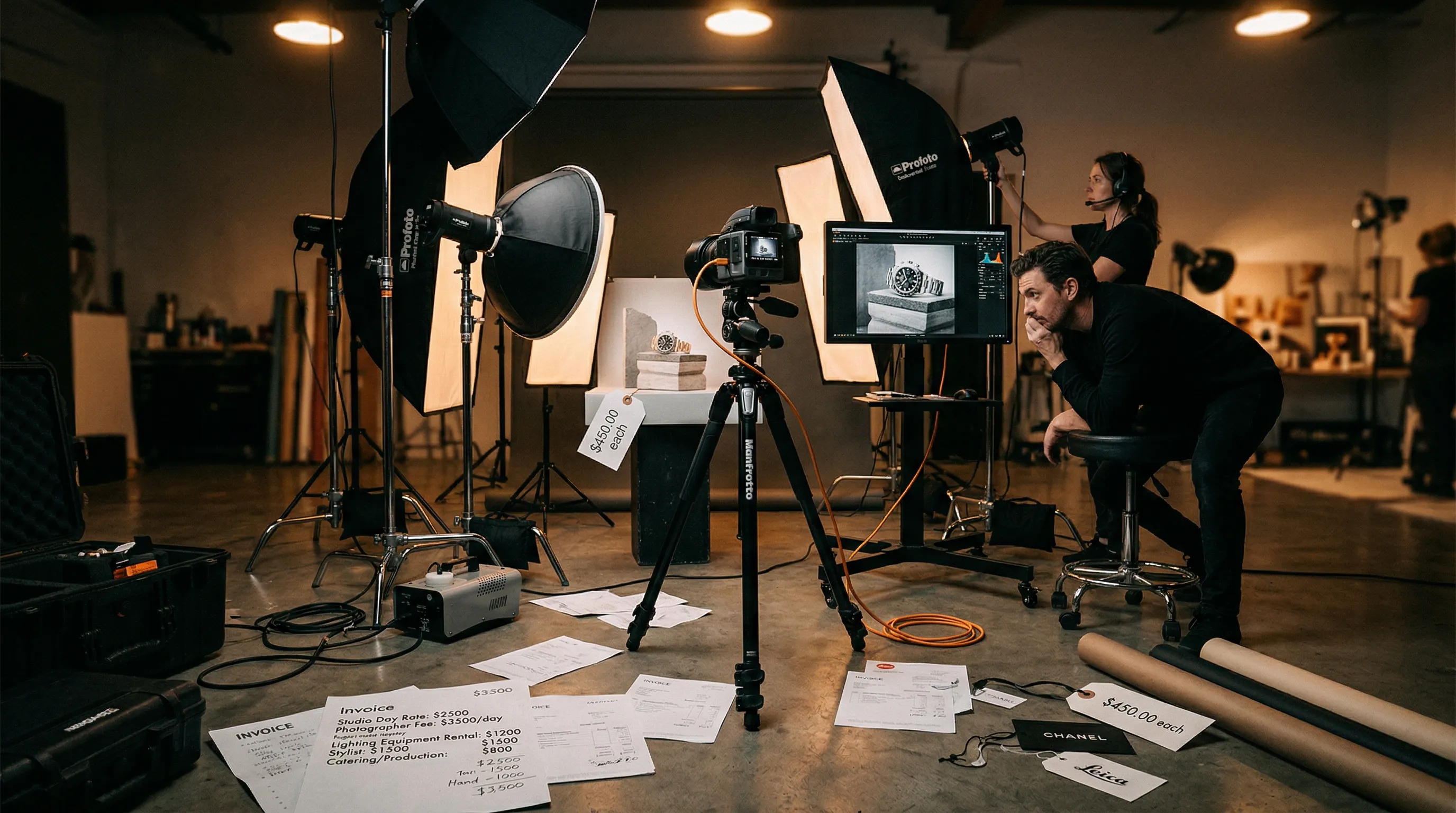
Product photography does not have one reliable average price. Shopify's January 2026 guide places photographer fees at about $500-$3,000 per day and finished-image pricing at about $50-$350 per image, with outliers on either side. The useful denominator is the approved image: divide the full production total (including setup, styling, retouching, logistics, licensing, revisions, and internal review) by the images you can actually publish. The cheapest workflow is the one with the lowest cost per approved image at the required risk level, not the lowest rate-card price.
How much does product photography cost in 2026?
Shopify's 2026 product photography guide uses a planning range of $500-$3,000 per photographer day or $50-$350 per finished image. Those figures are broad reference ranges, not a universal market average. A simple white-background batch, an on-model apparel shoot, and a styled hero image are different products with different labor, equipment, and usage terms.
The price also depends on what the quote measures. Before comparing two proposals, convert both to the same set of accepted deliverables.
| Pricing basis | What it usually measures | Budget risk to check |
|---|---|---|
| Per image | Each selected, finished photograph | Setup, minimum order, advanced edits, and licensing may be separate |
| Per product | A defined number of views for one product | Extra angles, variants, or difficult materials may change the rate |
| Hourly or daily | Production time | The number of usable final images is not guaranteed by the rate alone |
| Project fee | A negotiated scope and deliverable set | Scope changes, revisions, talent, props, and usage may sit outside the fee |
| Subscription or credits | Access plus a monthly output allowance | Resolution, failed work, exports, and review labor need separate checks |
The useful comparison is effective cost per approved image, not the lowest number printed on a rate card. A cheap shoot that produces few usable images can cost more per publishable asset than a higher quote with clear preparation, retouching, and usage rights included.
Which costs belong in a complete product photography budget?
A complete product photography budget includes every cost required to turn a brief into approved, legally usable files. The photographer or image-generation fee is only one row.
| Cost category | What to include | Question for the quote |
|---|---|---|
| Capture or generation | Photographer, studio service, equipment, or software subscription | What exactly counts as one paid deliverable? |
| Pre-production | Brief, shot list, samples, creative direction, scheduling | Is planning included or billed separately? |
| Set and talent | Studio, location, props, stylist, models, hair, makeup | Which people and spaces are included? |
| Post-production | Selection, color work, cleanup, compositing, exports | How much retouching and how many file versions are included? |
| Logistics | Packing, shipping, insurance, storage, returns | Who pays for product movement and damage risk? |
| Revisions and speed | Revision rounds, reshoots, rush delivery | What triggers another fee? |
| Rights and usage | Media, territory, duration, exclusivity, transfer terms | What may the brand publish, where, and for how long? |
| Internal labor | Briefing, approvals, product checks, file management | How many team hours does the workflow consume? |
Shopify identifies experience, shot type, equipment, location, project scope, editing, and turnaround as pricing factors. Its 2026 guide also reports rush fees from 25% to 200% of the job cost. Treat that as a reason to ask for the vendor's rush policy, not as a surcharge to add automatically to every budget.
How do usage rights affect product photography cost?
Usage rights can change the price and the value of the finished photographs, so the contract should state who owns the copyright and what the brand may do with the files. The U.S. Copyright Office's guidance for photographers says, "Generally, the author and initial copyright owner of a photograph is the person who 'shoots' or 'takes' the photo." Work-made-for-hire and written transfer or licensing terms can produce a different result.
Ask whether the fee covers product pages, marketplaces, organic social, paid ads, email, packaging, print, and international use. A brand does not automatically own the copyright merely because it paid for the shoot or supplied the product. This is general budgeting guidance, not legal advice; have counsel review terms when the rights are commercially important.
What do current product photography rate cards show?
Current vendor rate cards show why a single average can mislead: even relatively simple ecommerce work is packaged differently. The examples below were verified on September 3, 2026 and describe advertised prices, not negotiated quotes or market benchmarks.
| Source | Advertised price example | Included or separate items |
|---|---|---|
| ProShot Media | General products at $15 per photo plus a $100 setup fee; clothing at $20-$25 per photo | Retouching and color correction included; 15% discount on orders of 50 or more; models and several add-ons separate |
| soona | $39 per photo plus a $149 studio pass for a one-off booking | One touch-up included; premium edits from $9; models, styling, and upgrades separate |
| Shopify's 2026 guide | $50-$350 per finished image or $500-$3,000 per photographer day | A cross-market planning range; support staff, equipment, location, editing, and licensing can raise the final cost |
These examples are not directly interchangeable. Product complexity, service level, location, rights, turnaround, and the definition of a finished image can all differ. They are useful for understanding rate structures and for checking whether a quote has omitted a cost category.
What does a representative 100-image order cost?
A representative 100-image calculation makes the packaging difference visible without pretending to estimate the whole market.
Using ProShot Media's published general-product rate, the listed calculation is ($15 x 100 images + $100 setup) x 85% = $1,360, or $13.60 per finished image after the advertised 15% bulk discount. Using soona's one-off Studio Pass, the listed calculation is $39 x 100 images + $149 = $4,049, or $40.49 per image before optional premium edits, talent, styling, logistics, tax, and internal labor.
Both calculations use public rate cards as of the review date. They are representative worked examples, not quotes for your products and not evidence that one provider is better. Send the same written brief and deliverable list to several suitable vendors before making a budget decision.
How should a brand calculate its annual product photography cost?
Annual product photography cost should be built from a workload forecast and actual vendor terms, then divided by approved deliverables. Start with the number of images the brand intends to publish, not the number of products alone.
Use these formulas:
Annual image need = core listing images + campaign images + variant images + channel-specific versions + planned replacements
Annual total cost = external invoices + software + logistics + internal labor + contingency
Effective cost per approved image = annual total cost / approved images published
Cost per product = annual total cost / products represented by approved images
The planning examples below are deliberately illustrative. Replace every assumption with the brand's own launch calendar and required views.
| Representative profile | Example workload assumptions | Illustrative annual image need |
|---|---|---|
| Focused catalog | 50 products x 4 core images, plus two 25-image refreshes | 250 images |
| Growing catalog | 500 products x 4 core images, plus four 100-image campaign batches | 2,400 images |
| Large catalog | 2,000 products x 4 core images, plus twelve 100-image campaign batches | 9,200 images |
Do not apply one vendor's small-order rate to thousands of images and call the result a forecast. At higher volume, request a project or annual quote that states throughput, service levels, revision terms, and what happens when a product is difficult to shoot. The cost-per-product worksheet gives a more detailed calculation method, while the AI subscription break-even guide explains how to compare a fixed software cost with avoided variable production work.
AI changes where the budget goes
AI product photography shifts more spending from physical production to software usage, source preparation, review, and correction. It can remove studio, talent, and shipping costs from a suitable image.
| Cost area | Traditional production | AI production |
|---|---|---|
| Primary charge | Per image, product, hour, day, or project | Subscription, credits, or metered usage |
| Required inputs | Physical product and production setup | Clear photographs and accurate product context |
| Variants | New capture, retouching, or compositing | Additional Generations or edits |
| Quality control | Selects, retouching, and approval | Product comparison, selection, and approval |
| Logistics | Shipping, studio, props, talent | File preparation, Library management, and publishing workflow |
Nightjar uses a monthly Subscription that replenishes a Team's shared Credits. According to Nightjar's current Credit and usage-fee guide, a completed 1K or 2K Product Photography Single shot or Edit Images output uses one Credit, and a completed 4K output uses two. A Photoshoot requests four images for two Credits total, and an entirely failed set costs zero. Single shots and Edit Images charge only completed outputs, and a retry after the built-in visual review adds no extra Credit. The cash cost per approved image depends on the current Subscription price, the output mix and the number of images the team approves.
Nightjar also changes the repeat-work part of the budget. A Product groups multiple Product Photos with a factual description and optional physical dimensions, giving future Generations more evidence about the item. A Recipe saves the Product Photography setup, such as Photography Style, Background, Framing or Pose, Custom Directions, and output settings, while deliberately excluding the Product itself. The Team can apply the same production direction to the next Product without rebuilding the brief, which is the mechanism behind Nightjar's catalog-consistency workflow.
That reusable setup is a reason to choose Nightjar when the next campaign repeats much of an earlier brief. Once the team has reviewed the Product evidence and saved the direction, another launch can start from those decisions instead of another round of selecting references, explaining lighting, and agreeing on output settings. The value is in repeat production as well as the generation fee; measure the coordination time in your own workflow.
What would one month of Nightjar production cost?
Consider an illustrative 20-product campaign using source photographs the brand already owns. The current Nightjar entry plan is $25 per month for 150 Credits, verified on September 16, 2026. Suppose the team generates six completed 2K Single shots per Product, or 120 candidates costing 120 Credits. It allocates the entire $25 subscription to this campaign, leaving 30 Credits for other work.
The following labor figures are planning inputs, not market rates:
| Budget item | Explicit assumption | Illustrative cost |
|---|---|---|
| Subscription | One month; 120 completed 2K Single shots within 150 Credits | $25 |
| Source preparation and setup | Two hours to select existing photos, check Product facts, and build the campaign Recipe at $30/hour | $60 |
| Review, corrections, and delivery | Four hours of team time at $30/hour | $120 |
| Incremental total | $25 + $60 + $120 | $205 |
Divide $205 by the actual approved count to calculate the result. If the team approves 80 images within these inputs, the cost would be $2.56 per approved image.
The $205 excludes tax, new source capture, shipping, specialist retouching, and any paid tools beyond Nightjar. It assumes existing equipment and usable sources. Add actual capture costs or an amortized share of earlier photography when calculating a full lifecycle cost.
For a brand with strong source photos and recurring campaign needs, Nightjar is worth choosing when keeping the Product evidence and setup ready for reuse reduces the work needed for each new brief.
When should a brand choose traditional, AI, or hybrid product photography?
The right production method depends on the image's commercial risk and repeatability, not on catalog size alone. Traditional, AI, and hybrid workflows each fit a different part of the image plan.
| Approach | Strong fit | Cost warning |
|---|---|---|
| Traditional | First capture of an unphotographed product, regulated label or claim imagery, exact fit or measurement proof, named talent, and marketplace slots that require the seller's own photograph | Physical production, logistics, talent, and change orders can dominate the budget |
| AI | Repeat listing, lifestyle, and campaign imagery from good source photos, seasonal scenes, channel formats, and catalog work that benefits from reusable direction | Budget source preparation and review time alongside Credits |
| Hybrid | Real source photography combined with AI for repeatable catalog and campaign variations | Budget both systems and define which image types may use generative changes |
Routine listing, lifestyle, seasonal, and channel images can run on AI once good source photos exist; reserve physical-production money for images that must document reality, such as a new product's first capture or regulated claim imagery. The traditional-versus-AI cost comparison and the guide to replacing part of a $10,000 Shopify photography budget cover those decisions in more detail.
Frequently Asked Questions
What is the average cost of product photography per image in 2026? There is no dependable single average across product categories and service levels. Shopify's 2026 planning range is $50-$350 per finished image, while current studio rate cards can sit below that range for standardized, high-volume work and above it for styled, on-model, or campaign production.
Why do two product photography quotes differ so much? Two quotes may include different shot types, setup work, product preparation, retouching, turnaround, revision rounds, talent, logistics, and usage rights. Compare the same number of approved deliverables under the same written brief.
What hidden product photography costs should I ask about? Ask about setup and minimums, props and talent, advanced edits, extra formats, rush delivery, revisions, reshoots, shipping, insurance, storage, licensing, taxes, and internal approval time. The full AI usage-cost checklist covers the corresponding questions for software plans.
How much should a small business budget for product photography? A small business should calculate a budget from its own image list and comparable quotes rather than a generic annual figure. Count required images by product and channel, add campaign work, price every production category, include internal labor, and keep a contingency for revisions or difficult products.
Is AI product photography always cheaper than a photographer? Once usable source photos exist, AI is often cheaper for repeatable variations, because it removes studio, talent, and shipping costs from each new image. A product without usable source photos needs a first capture.
Can AI replace a traditional product shoot completely? AI can replace many routine ecommerce variations, but it cannot document a product that has never been photographed.
How can I estimate the value of time saved by AI product photography? Track team hours for briefing, scheduling, shipping, selection, corrections, and publishing in both workflows, then multiply the difference by the relevant loaded hourly cost. The guide to measuring weekly product-photography time explains how to avoid turning a hypothetical time saving into a claim.
References
- Shopify - Product Photography Pricing Factors for 2026 - broad per-image and day-rate guidance, cost factors, and rush-fee range
- ProShot Media - Product Photo Pricing - current standardized studio rate card and add-ons
- soona - Product Photography and Video Pricing - current studio pass, per-photo, editing, talent, and membership prices
- U.S. Copyright Office - What Photographers Should Know About Copyright - copyright ownership and work-made-for-hire guidance
- Nightjar - Credit and Usage-Fee Guide - current Credit treatment, completed-output charging, and operational costs