
Quick Answer
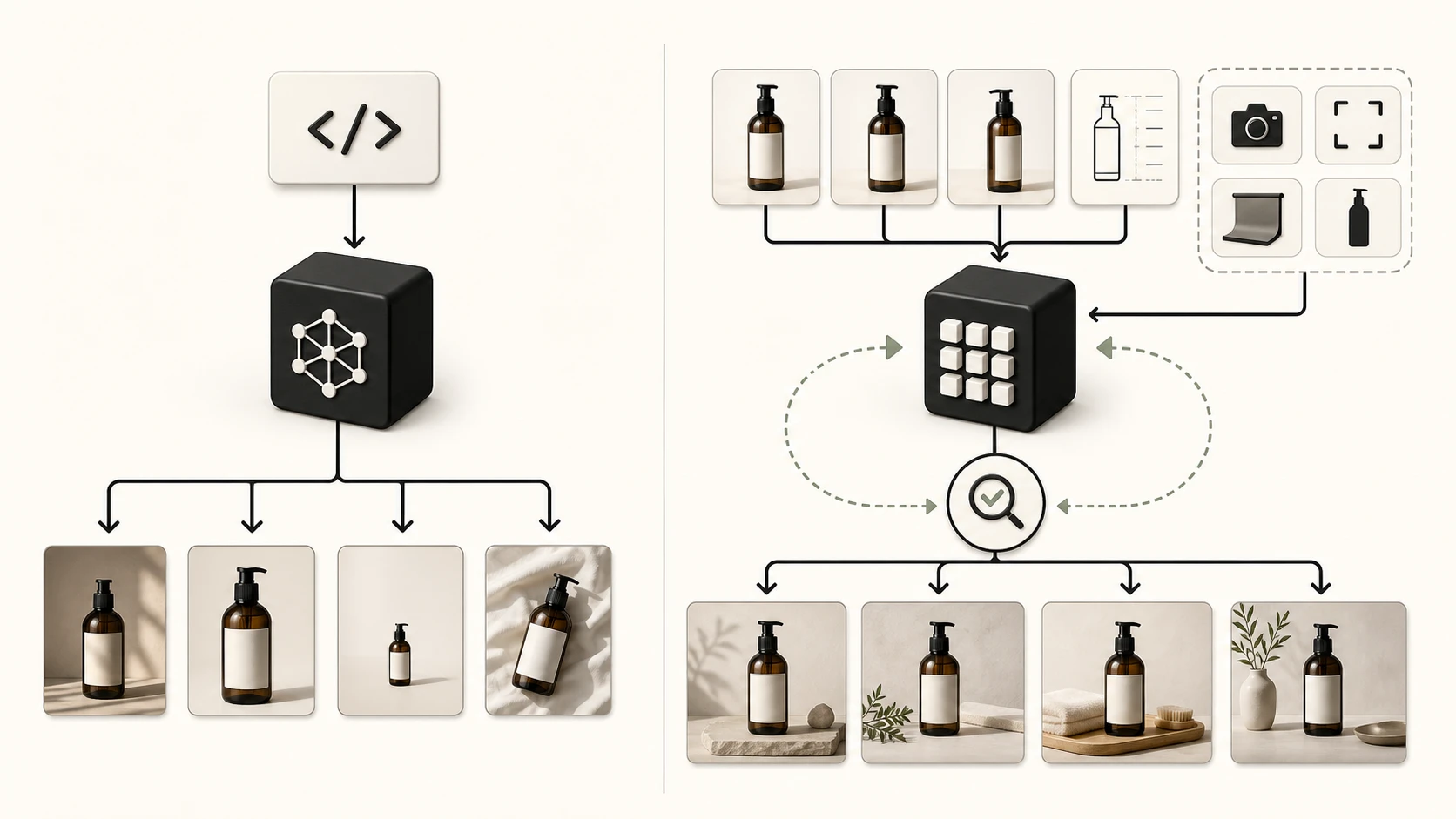
Use a general AI image API when the feature is narrow, each request can carry its own instructions, and your team wants to build the product-photography logic around the model. Use a specialized product-photography API such as Nightjar when consistency, product fidelity, reusable visual direction, high-volume operations, and predictable failure handling matter across many outputs. Nightjar's API is included with every paid plan, from $25 a month for 150 Credits, and has public documentation. A hybrid is often the soundest design: own the customer experience and business rules, then put image production behind a provider adapter. If a person rather than your own software will run the work, you may not need an integration at all: Nightjar can also be driven from Claude, Claude Code, or Codex.
What is the difference between a general AI image API and a product photography API?
The difference is the amount of product-photography behavior each API provides around image generation. A general AI image API exposes a capable image model; a specialized product-photography API also represents products, reusable visual direction, asynchronous production, and domain-specific quality policies.
General APIs are genuinely capable. Google calls its native Gemini image-generation family Nano Banana; the models can generate, edit, and iterate on images from text, images, or both. OpenAI's image-generation API likewise supports generation, editing, reference inputs, and output controls. A fair comparison should credit those capabilities instead of pretending that a general model accepts only text.
What a general image API does not give you is your product-photography application. Your team still decides how a product is represented, how creative direction is reused, which outputs pass review, what happens when one output fails, how tenants are isolated, and how a customer gets support.
| API choice | What your team still owns | What the API provides | Typical fit |
|---|---|---|---|
| General AI image API | Product identity, reusable direction, evaluation, generation state, storage, tenants, billing, and support | Image generation and editing, model-specific controls, and some safety handling | Narrow or distinctive use case with a capable platform team |
| Specialized product-photography API | Customer experience, business rules, integration, and vendor evaluation | Product resources, structured visual controls, quality policies, and generation operations | Repeated, embedded, or high-volume product photography |
Google's production-ML guidance captures the scale of the missing work in one sentence:
“Only a small fraction of a real-world ML system is composed of the ML code.”
The Google Cloud Architecture Center puts configuration, automation, data verification, testing, resource management, serving infrastructure, and monitoring around that small core. An image-model call is the core. The API choice determines who builds the rest.
Self-hosting or training a model is a separate third decision. It belongs in the comparison only when proprietary training data, deployment control, regulation, or measured economics make model ownership part of the product's advantage. Most teams comparing Nano Banana or another hosted model API with a specialized product-photography API are not deciding whether to operate GPUs.
What does your team still have to build around a general AI image API?
A team using a general AI image API owns every product-photography rule, failure, and policy decision between the user's upload and an accepted, delivered product image.
The happy path looks compact: accept a reference image and instructions, call a model, store the result. Production adds durable state and ambiguous outcomes. A request can time out after the provider has accepted it. Four requested images can produce three usable files and one policy failure. A product with readable packaging can return a plausible bottle with the wrong label. A tenant can exhaust shared capacity. A support ticket can arrive with no way to connect the customer's action to the provider attempt.
The useful scope is finite, but it is much larger than inference:
| Area | What the team must add around the general API |
|---|---|
| Model | Provider selection, model evaluation, migrations, fallbacks, prompt and reference translation |
| Product domain | Reference handling, durable product identity, variants, factual descriptions, dimensions, output provenance |
| Creative direction | Reusable style, background, pose, framing, person identity, output settings, per-request exceptions |
| Quality | Acceptance criteria, review queues, automatic checks, retry policy, false rejects, failure charging |
| Reliability | Asynchronous execution, idempotency, stable result records, partial success, quotas, burst control, backoff |
| Application | Uploads, storage, multi-tenancy, authorization, moderation, entitlements or billing |
| Operations | Logs, metrics, request correlation, incidents, support tools, API docs, compatibility, deprecation |
Provider churn is real even when the vendor remains healthy. OpenAI announced the DALL·E 2 and DALL·E 3 deprecations on November 14, 2025 and removed both models from the API on May 12, 2026. A direct integration had to evaluate a replacement, translate inputs, retest output quality, update cost models, and ship the migration. A domain provider can absorb that work behind its contract. A system built around a general API owns it.
Async work carries a similar tax. AWS guidance for asynchronous services calls out durable acknowledgement, idempotency, status endpoints, polling with backoff, failed-message handling, and correlation. These are ordinary distributed-systems concerns, but image generation makes them unavoidable because the work is slow, expensive, and fallible.
How should a team evaluate product fidelity when using a general AI image API?
Product fidelity is a measurable acceptance policy, not a promise that a reference image will always survive generation intact.
Create an evaluation set from your own catalog. Include shapes that must not change, color-sensitive materials, transparent or reflective items, readable packaging, small brand marks, and multi-product scenes. Define which differences are an automatic rejection, which need human judgment, and which are harmless variation.
Reference support helps, but it does not settle the question. OpenAI's own guide says current image models can still struggle with precise text, recurring brand elements, and layout-sensitive placement. The product team still needs a review and retry policy. Our guide to preventing product-shape changes in generated scenes covers that failure mode in more depth.
How should you compare a general AI image API with a specialized product-photography API?
The right API follows from eight factors: differentiation, capability, time to market, control, workload shape, cost shape, reliability ownership, and switching risk.
| Factor | General API signal | Specialized API signal | Question to ask |
|---|---|---|---|
| Strategic differentiation | Your own image behavior is part of the product's defensible value | Product images enable another product advantage | Would customers choose us because our image system behaves differently? |
| Engineering and ML capability | A named team owns product-photo evaluation, migrations, and incidents | The current team can integrate an API but should not build the whole domain stack | Who is on call when quality drops after a model change? |
| Time to market | The launch can wait while the team builds the production scope | Learning from real users matters sooner | Which responsibilities must exist before the first paying customer uses it? |
| Required control | Custom request logic or model-specific controls are central | Structured product-photo controls satisfy the real use case | Which requirement is impossible through the specialized API? |
| Volume and burstiness | The team already operates the required queues and capacity policies | The provider's asynchronous generation lifecycle can absorb uncertain, seasonal, bursty, or project-based demand | Is this embedded traffic, a one-time bulk run, or recurring production? |
| Cost shape | The extra engineering and review work is measured and justified | Domain features reduce the cost per accepted output | What is our cost per accepted output, including labor? |
| Reliability ownership | Reliability is a capability the company wants to operate | The team wants one supported product-photo generation contract | Who owns retries, partial failures, and customer recovery? |
| Switching risk | A thin model adapter is worth the larger internal system | Vendor resource semantics transfer substantial work | Which records can we export, and how would we replace the provider? |
Do not let a single factor decide the whole case. Very high volume does not automatically make a general API cheaper once internal review, retries, and operations are counted. A marketplace with strong ML staff may still choose a specialized API because its advantage is seller liquidity and workflow, not product-image infrastructure.
Workload shape deserves special care. An embedded image feature has unpredictable customer traffic and a product-facing reliability promise. A one-time 10,000-image catalog project can use scripts, review queues, and a planned stop date. Recurring automated production needs stable scheduling and long-term monitoring. All three can be high volume. Only the third is inherently continuous automation.
How should you compare the full cost of a general image API with a specialized product-photography API?
Cost per model call understates the cost of a general image API because rejected outputs, review, storage, engineering, support, and incidents do not appear on the provider invoice.
Use the delivered result as the denominator:
cost per accepted output =
  (model and retry calls
   + storage and egress
   + review labor
   + engineering and maintenance
   + support and incident cost)
  / accepted outputs
The accepted-output rule prevents two common mistakes. First, a failed or visibly wrong image does not become cheap merely because inference cost pennies. Second, staff time should not disappear from the spreadsheet because the engineers are already employed.
For a 10,000-image project, let y be the acceptable-output yield measured on your own product set. Render demand begins at 10,000 / y, before storage, review, and delivery. Do not borrow a vendor's yield or invent a general benchmark. A 200-product evaluation can give you a real value for y, split by the product classes that matter to your business.
| Workload | Cost pressure | Often missed |
|---|---|---|
| Embedded customer feature | Bursts, abuse, tenant fairness, support | Idle capacity, incident response, per-customer entitlements |
| One-time 10,000-image project | Throughput, review staffing, retry volume | Temporary tooling that becomes permanent by accident |
| Recurring production | Stable unit cost, monitoring, migrations | Model drift, evaluation upkeep, contract maintenance |
A product-photography provider can cost more per nominal image and less per accepted output if it removes enough review, retry, integration, and operating work. A mature internal system can win at sustained scale when its measured yield and utilization support the fixed commitment. The measurement decides. Sticker price does not.
When should you build product-photography logic around a general AI image API?
Build product-photography logic around a general AI image API when your own image behavior is strategically valuable and the organization accepts a permanent evaluation and operations commitment.
Five tests make that case credible:
- The behavior is part of the moat. Proprietary product data, customer feedback, or an unusual generation method produces an advantage a vendor contract cannot reproduce.
- A hard requirement rules vendors out. On-premise deployment, a specific region, retention terms, latency, auditability, or a regulated workflow is mandatory.
- The team exists after launch. Named owners cover model evaluation, platform reliability, security, cost, support, and migrations.
- The economics are measured. A representative pilot shows lower cost per accepted output after staff, review, idle capacity, and incidents.
- The company wants the commitment. Leadership understands that model and provider changes create recurring work rather than a finished infrastructure project.
There is also a smaller general-API case. A narrow, low-risk feature may need one reference image, one output, light consistency, and human review. Building a thin adapter around a general model API can be entirely sensible. Keep the scope honest. The moment the feature adds saved products, shared direction, customer billing, queues, and reliability promises, the architecture has changed.
Self-hosting is a further decision. Calling a general model API gives you custom product logic without GPU operations. Training or serving a model should require a separate argument based on data, deployment, or economics. It is not the default meaning of “build.”
When should you use a specialized AI product-photography API?
Use a specialized AI product-photography API when product photography supports the customer value proposition but the company's advantage lies in its workflow, marketplace, catalog data, or distribution.
The strongest vendor value is transferred responsibility. A useful API should carry more than a render endpoint: it should provide durable product and image resources, reusable creative direction, a defined generation lifecycle, and recoverable failure semantics. That lets your engineers spend their time on how image creation fits the customer journey.
Vendor review should stay concrete:
- How does the API represent one product across multiple reference views?
- Which creative decisions can be stored and reused?
- Can resources be created programmatically, or is web-app setup required?
- How are generation requests admitted, retried, polled, and correlated with support?
- What survives when some requested outputs fail?
- Which outputs are charged, and who pays for provider retries?
- How are tenants, credentials, deletion, retention, and moderation handled?
- What compatibility and deprecation promise protects the integration?
- Can inputs, metadata, accepted outputs, and evaluation results be exported?
A single background swap that an employee reviews by hand needs no integration at all, general or specialized: a web app does that job. For an embedded product, repeated catalog work, or a customer-facing reliability promise, the domain and operational surface can remove years of small obligations that otherwise accumulate inside the buyer's codebase. The comparison of nine AI image generation APIs for ecommerce applies questions like these to current providers, including product context, job and retry behavior, and cost per approved asset.
What should a production-grade AI product-photography API provide?
A production-grade product-photography API should preserve both the product being photographed and the reusable direction used to photograph it.
Nightjar's public API contract is one concrete design. API clients can create Team-owned Products programmatically, without preparing them in the web app. A Product groups one or more Product Photos and can include a factual description and physical dimensions. When more evidence is available, the system can reuse those views and facts instead of reconstructing the subject from one loose image on every request.
The photographic direction is represented separately. API clients can create reusable Photography Styles for camera feel, lighting, mood, and color; Backgrounds for repeat scenes; Poses for a Fashion Model's body arrangement; and reusable Fashion Models for the person in the shot. For product-only images, Product Photography requests add Framing and can add Shadow when the background is a flat color. When a Fashion Model appears, Camera Distance controls the crop. Aspect ratio, resolution, and format remain explicit request fields.
This separation is the consistency mechanism. Products preserve what is being photographed. Reusable ingredients preserve visual direction, while explicit request fields let the client reapply fixed controls across a catalog. The public API does not take the web app's Recipe IDs, so an integration stores its chosen resource IDs and request settings, then submits that direction with each Product Photography Generation. The deeper guide to maintaining a consistent aesthetic across AI images explains why reusable direction holds up better than rebuilding a prompt for each product.
Product context also supports fidelity review. Nightjar's built-in visual review compares supported outputs with their references and request. It can catch obvious eligible failures such as a substituted or missing product, broken readable text or brand marks, or a catastrophic image defect, then retry before returning the completed output without consuming another user Credit. This is an extra layer of protection, not a guarantee of exact shape, color, text, or material.
| Concern | Raw model call | Nightjar API contract |
|---|---|---|
| Product identity | Caller assembles references per request | Product with multiple Product Photos, description, and dimensions |
| Creative direction | Prompt and provider-specific inputs | Reusable ingredients plus dedicated product-photography controls |
| Work lifecycle | Provider-specific response | Pollable Operations and Generations |
| Safe retries | Caller-defined | Required idempotency for side-effecting admissions |
| Multi-output failure | Caller-defined | Stable output slots with successful Assets and failed-slot errors |
| Support correlation | Caller-defined | Request IDs and Team-wide Generation history |
| Charging | Provider-call rules | Single shots, Edit Images, and Upscale are charged per completed output; a Photoshoot costs two Credits if any output completes, zero if all fail |
The public surface exposes Team resources and three Workflows: Product Photography, Edit Images, and Upscale. Product Photography can use Product IDs, loose Asset IDs, or both. Edit Images transforms one or more Assets from written instructions. Upscale brings an Asset to a 2K or 4K target. Creative work returns asynchronous, pollable Generations; reusable-ingredient authoring that needs analysis or generated media returns Operations.
That contract can sit behind an embedded image feature, a one-time project such as 10,000 images, or recurring automated production. The workload does not have to be automated to use the API, and high volume does not imply a special batch endpoint. The caller can create the Products and reusable ingredients it needs, submit the work, and retain its own review or publishing step. The practical guide to generating product photos in bulk with Nightjar explains how to orchestrate a separate Generation for each Product.
Nightjar includes API Access with every active paid Subscription, from $25 a month for 150 Credits. A Team owner creates a read-only or full API Credential in Settings, and each credential acts within that Team's Products, Library, Credits, and Subscription. Plans start at 150 Credits per month, while custom large-catalog plans support companies whose one-time or recurring volume does not fit a self-serve tier.
Not every catalog job needs that integration. When a person rather than software supervises the work, Nightjar also runs inside Claude, Claude Code, and Codex through MCP, the open standard AI assistants use to connect to other tools. The person signs in to their Nightjar Team instead of handling an API Credential, then asks for the job in plain language: apply one setup to 80 saved Products, show a few samples first, then run the rest. Nightjar plans that as a batch of up to 100 items with its total cost and a Credit ceiling, keeps running the approved work after the chat closes, and lets the person pause, resume, or stop it from a new conversation. The results land in the same Team Library, built from the same Products and reusable ingredients the API uses, so a team can measure acceptable-output yield on its own products before anyone writes integration code. The assistant connection does not replace the API. An embedded feature, or recurring production triggered by your own systems, still belongs on the server-to-server contract, and the reliability tests later in this guide need it. The Nightjar MCP guide lists the tools, batch limits, and Credit rules, and product photography in Claude covers setup for non-developers.
When is a hybrid general-and-specialized API architecture the better choice?
A hybrid API architecture is the better choice when a company wants to keep its differentiating customer workflow in-house while placing volatile image-production details behind a provider adapter.
The buyer should usually own:
- the user experience and product permissions;
- catalog mappings and business rules;
- customer entitlements and the product's billing model;
- the evaluation corpus, acceptance thresholds, and release gates;
- a narrow provider interface inside its own application.
The provider can own model selection, domain image resources, generation operations, quality retries, and the public asynchronous contract. This split gives the buyer room to change the customer workflow without rebuilding image infrastructure, and room to replace a provider without rewriting every product surface.
In a catalog pipeline, that boundary sits inside your backend. With Nightjar, for example, the PIM, DAM, commerce platform, or product database stays the source of record. Your adapter reads a SKU's photos and facts, uploads the photos as Assets, creates or updates a Nightjar Product through the API, and stores the returned Product ID and chosen ingredient IDs beside the SKU. It then submits a Product Photography Generation with an idempotency key, polls until the Generation completes or fails, and passes accepted Assets to your own review, DAM, or storefront step. Nightjar does not connect to a PIM or DAM by itself; that mapping is the adapter you own, and it is also what keeps the provider replaceable. The API quickstart for Product Photography walks through the first upload, request, and poll.
Portability requires records. Keep original uploads, stable internal product IDs, product facts, structured creative intent, accepted outputs, provider references, and evaluation results in an internal representation. Do not reduce a useful provider's richer concepts to one giant prompt merely to claim theoretical portability. Map them deliberately at the adapter boundary.
Multiple providers are optional. A fallback is valuable only after its product fidelity, creative controls, error behavior, and cost have been tested on the same evaluation set. Sending failed work to an unevaluated second model moves the failure; it does not create resilience.
How should you test general and specialized image APIs before committing?
A representative API test should compare accepted outputs and operating work on the same product set, not compare demo images made from different inputs.
Build a stratified evaluation set from the catalog you expect to serve. Include ordinary packshots, reflective and transparent products, text-bearing packaging, multiple reference views, apparel or model work where relevant, and the edge cases that already create support tickets. Hold the input images, requested direction, formats, and reviewers constant across options.
| Measure | What it reveals |
|---|---|
| Acceptable-output yield by product class | Real quality and fidelity, rather than average visual appeal |
| Review minutes per accepted output | Human cost hidden by per-call pricing |
| Retry count and failure category | Model weakness and pipeline policy |
| p50 and p95 completion time | Typical experience and tail behavior |
| Partial-success recovery | Whether one failure discards good work |
| Burst behavior | Queueing, concurrency, and tenant fairness |
| Support investigation time | Quality of logs, request IDs, and generation history |
| Delivered cost | Full cost per accepted, stored output |
| Migration exercise | Switching cost and data portability |
Test ugly paths on purpose. Replay the same request after a simulated timeout. Delete an input. Rotate a credential. Force one slot in a multi-output request to fail. Export the records needed to reproduce an accepted image. Replace the model or provider behind a small sample and measure the quality shift.
Write the decision thresholds before viewing the results. That keeps one beautiful demo image from outweighing poor reliability or labor. Readers designing the broader catalog system can continue with the high-volume AI product-photography stack, while teams building fidelity tests can use the guide to why AI product photos diverge from the real product.
Frequently Asked Questions
The common questions reduce to the ownership boundary, the evidence required to move it, and the records needed to change course later.
Does using a general image-model API mean we are building everything ourselves?
No. It buys model inference while leaving product identity, creative reuse, evaluation, generation state, storage, tenancy, billing, observability, and support to your team.
Do we need ML engineers to build around a model API?
Not for the first API call. Production evaluation, provider migrations, quality regressions, and model-specific failure analysis still need explicit ownership and often benefit from ML experience.
Is a specialized product-photography API always faster to integrate?
A specialized API transfers more of the system, but integration speed depends on its resource model, your tenant and billing design, security review, and the distance between the vendor contract and your product.
At what volume does a general image API become cheaper than a specialized product-photography API?
There is no universal image count. Compare full cost per accepted output using your measured yield, review time, retry rate, utilization, engineering, storage, support, and incident load.
Does bulk image production require automation?
No. A one-time 10,000-image project may use scripts and human review, while recurring catalog production may be automated. Volume describes quantity; automation describes how the work is initiated and supervised.
How do we reduce vendor lock-in?
Keep portable source files, internal product IDs and facts, structured creative intent, accepted outputs, evaluation results, and a narrow provider adapter. Test an export and replacement path during the pilot.
Can a hybrid use several image providers?
Yes, after every route is tested against the same acceptance criteria. Provider diversity without equivalent quality and failure handling creates more branches to operate, not dependable fallback behavior.
What should a product-photography API expose beyond generation?
Look for durable product and image resources, reusable creative direction, asynchronous generation lifecycles, idempotency, partial-success semantics, storage and provenance, authorization, usage or billing signals, observability, support correlation, and a compatibility policy.
References
These primary sources support the article's production-system, image-model, reliability, and evaluation claims.
- Nightjar API documentation - Product-photography resources, Workflows, Operations, and Generations
- Google Gemini API image-generation guide - Nano Banana image generation, editing, and reference-image capabilities
- Google Cloud MLOps guidance - The production system around model code
- Google Cloud guidance for operating generative-AI applications - Evaluation, monitoring, lineage, access control, and load testing
- Google Research ML production-readiness rubric - Testing and monitoring needs for production ML
- OpenAI image-generation guide - Current image API capabilities, limits, errors, and cost structure
- OpenAI API deprecations - Image-model retirement example
- AWS guidance on idempotent APIs - Safe retries and caller-provided request identifiers
- AWS asynchronous communication guidance - Polling, backoff, failure handling, and correlation
- NIST AI RMF Core - Testing and monitoring AI systems before and during operation