
Quick Answer
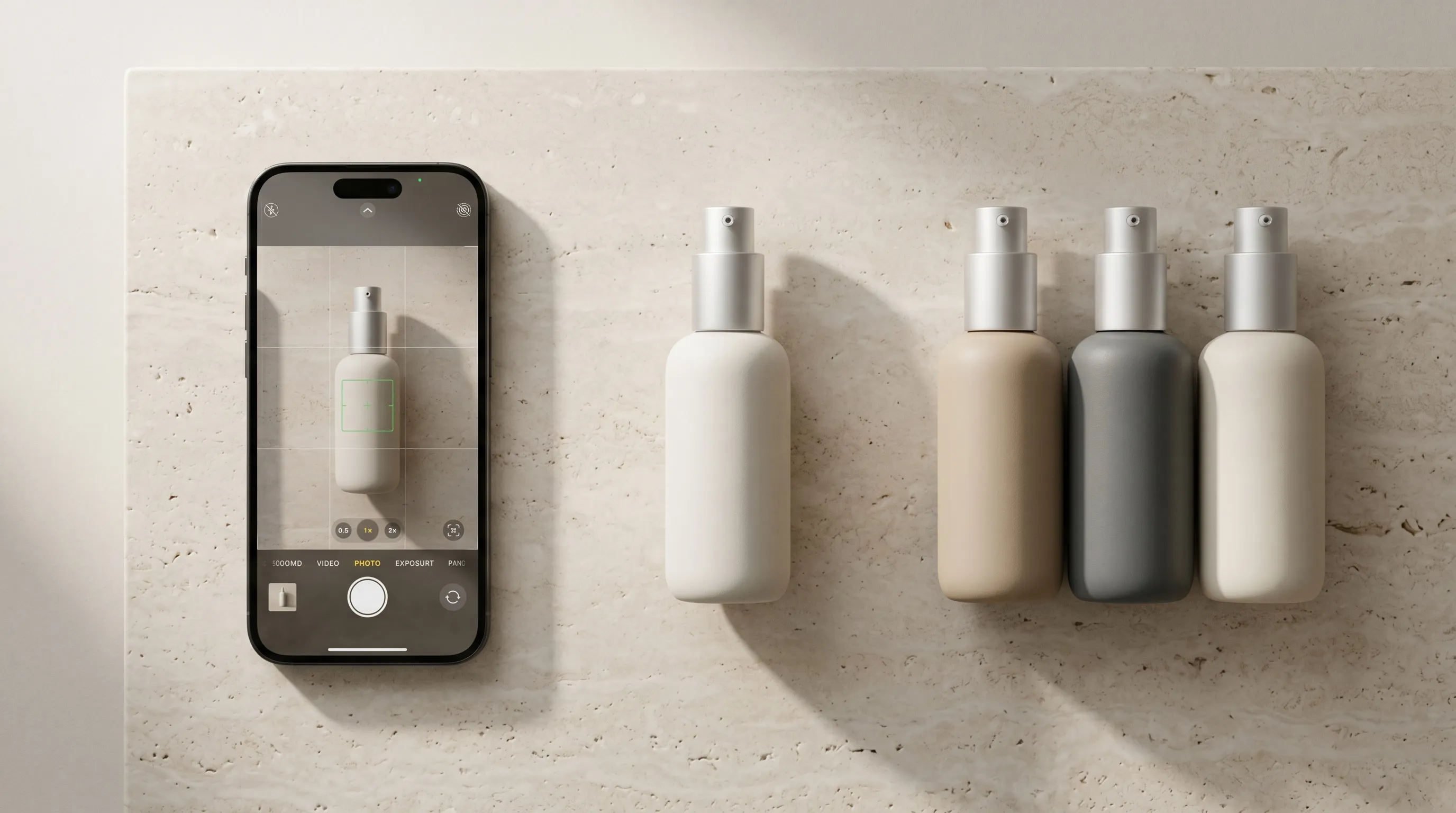
An iPhone and AI product photography do different jobs. The iPhone captures the real product, including details a generator cannot know from an unseen angle. Systems like Nightjar are useful for expanding reviewed source photos into scenes, on-model images, and repeatable creative treatments. Use physical capture for evidence-critical detail; use a hybrid workflow when the bottleneck is producing variations from that evidence.
The iPhone vs AI Question Most Operators Are Actually Asking
The framing on the SERP is dishonest in both directions. iPhone-photography blogs treat AI as a vague filter that gets bolted onto a real shoot. AI tool blogs imply the phone is obsolete and that everything from variants to hero shots can be generated cold. Neither matches what operators actually do.
The real question in 2026 is not "iPhone or AI." It is which job each tool does well, and how they wire together. The iPhone is a general-purpose camera. Nightjar is a specialist production system for ecommerce imagery. Comparing them on cost-per-image is a category error. They sit in different layers of the same pipeline.
The rest of this post is a scenario guide. iPhone wins where physical truth matters most. AI wins where scale matters most. A hybrid pipeline is useful when you need both accurate source capture and repeatable creative variations.
What an iPhone Pro Actually Captures in 2026
A recent iPhone Pro can supply ecommerce source photos when lighting, focus, and working distance are suitable. The following specs are for the iPhone 17 Pro, not every model bearing the Pro name:
- 48 MP main Fusion sensor at f/1.78
- 48 MP ultra-wide that doubles as a macro camera
- Telephoto reaching 8x optical-quality on the iPhone 17 Pro
- Apple ProRAW capture at 12 MP or 48 MP for color editing latitude
- 4K Dolby Vision video for behind-the-scenes and unboxing content
For a founder or small team, those are useful capture options. ProRAW adds editing latitude, but neither megapixels nor a RAW file guarantees accurate color. Keep a neutral reference in the setup, use consistent light, and compare the edited photograph with the product.
The iPhone is not perfect. Automatic white balance and image processing can change how a color appears, so avoid treating the camera's first rendition as a color standard. The linked Practical Ecommerce comparison is a 2014 discussion of phones including the iPhone 6—not a current iPhone 17 Pro color test. Its durable advice is to invest attention in lighting and stability. For current product work, judge your own source photograph against the object.
Where the iPhone Genuinely Wins
- Raw material and texture capture: knit, leather, ceramic, jewelry surfaces, food textures.
- True color reference for buyers, especially in categories where mismatch drives returns.
- Behind-the-scenes, founder, and unboxing content where realness is the point.
- Regulatory or trust-sensitive categories like supplements, food, and medical-adjacent goods.
- Source images that feed into an AI production system.
The iPhone's job here is evidence: photograph the real object, then correct and review the image so it represents that object faithfully.
What AI Product Photography Actually Does Well in 2026
AI product photography is useful when one real product needs several presentations: different environments, channel crops, or a repeatable visual treatment across a collection. Start with the images buyers need to understand the item, rather than a universal number of pictures per SKU.
AI is not a substitute for missing evidence. It may alter small text, material, liquid appearance, or details on a side the source does not show. Use photographs of the critical views as inputs and compare generated outputs against them. The broader tool guide covers different production options; the practical question here is which views must remain photographic and which scenes can be generated.
Where AI Genuinely Wins
- Visualizing color variants when you have an accurate reference for the actual variant; photograph unrepresented material details.
- On-model imagery without booking talent or shipping samples.
- Lifestyle scenes the brand cannot physically build (hotel suite, beachside cafe, snowy mountainside).
- Reusing a creative direction across a catalog instead of re-briefing each image.
- Preparing channel-specific images, followed by checks against Amazon's main-image requirements or Shopify's image-size guidance.
AI's job is scale. It uses source evidence and reusable direction to produce variations; the seller still decides which accurately represent the product.
The Scenario-by-Scenario Verdict
This is the matrix the SERP currently lacks. Each row names the scenario, the best tool for it, and why. The verdict is honest. AI does not win every row, and the iPhone does not either.
| Scenario | Best Tool | Why |
|---|---|---|
| Hero close-up of jewelry, watches, or diamond detail | iPhone or studio | Capture the actual facets, engraving and surface finish. A dedicated macro setup may be needed. |
| Translucent liquids, beverages, perfume, oils | iPhone or studio | Actual fill level, transparency and refraction are useful evidence. |
| Food and beverage hero shots | iPhone or studio | Show the actual texture, ingredients and serving presentation. |
| Founder, unboxing, behind-the-scenes content | iPhone | The event and people are the subject, not an invented scene. |
| Trust-sensitive or regulated products | Physical capture plus applicable review | A photograph is not by itself proof of compliance, but it records the actual item. |
| First product shot for a brand-new SKU | iPhone, then possibly AI | Build the source set before expanding it. |
| A catalog needing consistent creative treatments | AI (Nightjar) or a standardized studio workflow | Reusable Styles and Recipes reduce repeated creative setup; SKU count alone does not decide. |
| Color variants of the same SKU | AI with a real variant reference, or photography | Use Recolor for the intended change and verify the actual shade and unchanged material. |
| On-model fashion, accessories, eyewear | AI (Nightjar) or studio | Generated presentation avoids some casting and setup work; physical capture is preferable when actual fit or movement is the claim. |
| Lifestyle scenes the brand cannot physically build | AI (Nightjar) | Backgrounds and Product Placement can support contextual variations. |
| Marketplace main image on white | Photography plus editing, or reviewed AI output | Both need final background, product and category-rule checks. |
| Quick background swap on a single shot | A focused editor such as Photoroom | Consider the smallest workflow that handles the task; this is not a measured speed comparison. |
| Catalog refresh across legacy SKUs | Hybrid | Update weak source views, then reuse an approved direction. |
| Seasonal campaign across multiple SKUs | Hybrid | Capture real product detail; generate suitable scenes and aspect-ratio variations. |
The Hybrid Pipeline (How Operators Actually Run This in 2026)
A hybrid pipeline is a useful choice when you have physical products to record and more creative treatments than you want to stage. Shoot and review the source, export a supported image file, then use saved Recipes for the recurring production direction. Keep capture and generation as separate decisions.
The Seven-Step Hybrid Workflow
- Shoot the product with controlled lighting. Use ProRAW on a supported iPhone when you need its editing latitude, and photograph critical sides and details.
- Correct and review the source, then export JPEG or PNG. ProRAW is DNG; Nightjar accepts JPG, PNG, GIF, WebP, and AVIF, not a direct DNG or HEIC upload. Create a Product from the supported files and choose its Main Photo.
- In Create, select the Product and apply a saved listing Recipe—for example a Photography Style, product-only Framing, white Background color, and output settings. Add a critical view as an Additional Photo when needed.
- Apply a separate lifestyle Recipe for the contextual frames. Recipes do not select the Product, Additional Photos, or output mode; choose those for the current job.
- For on-model work, select a reusable Fashion Model in Create. Alternatively, Try On in the Edit tab uses garment and person Assets on the Canvas; it is a separate editing operation, not a Recipe applying itself.
- If useful, choose Photoshoot output mode to make four related images at 1K or 2K. Review their product details and coverage rather than assuming all four are ready for the gallery.
- Upscale a selected finished Asset to 2K or 4K when more pixels are needed, then inspect text, logos, texture, and the final marketplace requirements.
Worked Example: 30-SKU Skincare Brand
Suppose a skincare brand with 30 SKUs needs 5 frames per SKU: a hero, two angles, an in-bathroom shot, and a lifestyle frame on a marble counter. That is 150 finished frames.
- Studio path. Ask for a quote covering 30 products, 150 final images, the required scenes, retouching, and usage. Pricing guides can help structure that request, but a generic per-image rate is not a quote for this job.
- iPhone-only path. Photograph the hero and two required angles of each product. The bathroom and marble-counter scenes add physical setup, props, capture, and editing time. A repeatable tabletop set may make that practical; an inaccessible location may not.
- Hybrid path. Photograph the same evidence-critical views, then use one listing Recipe (clean Style, suitable Framing, white Background color, 1:1, 2K, JPEG) and one lifestyle Recipe (marble-counter Background and soft-daylight Style). Select the relevant Product and Additional Photos for each run. Using standard Create outputs at 2K, 150 completed images would use 150 Credits before additional attempts or edits; keeping the 90 physical hero/angle photos and generating only 60 scene images would use 60 Credits. Photoshoot is a separate, four-image output mode with its own pricing.
The hybrid math is not iPhone-vs-AI on cost per image. It is iPhone-as-source-capture plus AI-as-production-layer, with the studio taking the highest-stakes hero shots when they exist.
Where the iPhone-Only Approach Breaks
A pure iPhone workflow runs into structural limits at catalog scale.
- Color drift between batches. Auto white balance and saturation enhancements vary across sessions and lighting conditions. The same product can read warmer in one shoot and cooler in the next, breaking catalog consistency.
- Scenes that are expensive to stage. A hotel-suite bathroom or snowy mountainside may be outside the shoot budget or schedule.
- On-model imagery requires talent. Booking models, shipping samples, and renting a studio for every colorway is slow and expensive.
- Uncontrolled catalog drift. Different rooms, lighting and camera settings can make successive batches look unrelated. A documented capture setup helps; a camera alone does not provide that system.
- Marketplace background requirements. A photographed white sweep may record as gray or tinted. Check the delivered pixels and current Amazon requirements; use background editing when necessary.
None of this means the iPhone is a bad camera. It means the iPhone is a generalist camera being asked to run a production system, which it was never designed for.
Where the AI-Only Approach Breaks
The reverse trap is just as real.
- No source, no fidelity. Without a real product image to anchor the Generation, AI drifts on label text, logos, fine material, and color. The product in the picture stops being the product on the shelf.
- Unseen views are not evidence. A front photo cannot establish what the back or underside looks like. Supply the required view instead of relying on an invented angle.
- Some categories resist generation. Highly transparent packaging, liquid surfaces, jewelry refraction, and ingredient-level food shots tend to need a physical capture.
- Hands-on brand moments cannot be faked. Founder content, factory tours, and behind-the-scenes work depend on actually being there. Trying to generate them backfires the moment a buyer notices.
- Misrepresentation has a price. In a 2023 PowerReviews survey, 56% of respondents cited a product not matching its description as a reason they had returned something. That is a share of surveyed shoppers, not a share of all returns. Product imagery should not create an expectation the item cannot meet.
The AI-only path tends to fail in the same place generic prompting fails: control. Without a real source and without reusable visual rules, every Generation is a fresh negotiation with the model.
How Nightjar Fits This Picture
Nightjar is built around the case where the iPhone has already done its job (true capture) and the brand needs to scale that one true frame into a coherent catalog. The iPhone is the camera. Nightjar is the production system.
Reusable ingredients turn one iPhone source image into a controllable system:
- Photography Styles for camera, lighting, mood, color, and atmosphere. 150+ ship with Nightjar; a custom Style uses exactly three reference images.
- Framing for product-only camera direction and crop; Pose and Camera Distance for on-model presentation.
- Fashion Models for identity continuity. 80+ ship with Nightjar; brands can build custom Fashion Models for on-model apparel, accessory, and beauty imagery.
- Background choices for no Background, a solid color, or a reusable scene Background.
Recipes save the reusable creative controls and output settings, leaving the current Product, Additional Photos, and output mode to the operator. A later batch starts from the same direction instead of someone's recollection of it. That is a repeatable setup, not a guarantee that two generated images have identical lighting or product detail.
The Edit tab handles Recolor, Try On, Product Placement, Reframe, and Change Format on Canvas Assets. Those operations are separate from a saved Create Recipe. Photoshoot produces four related images at 1K or 2K. Upscale targets a 2K or 4K long edge; inspect the result before treating small text or texture as verified detail.
For Teams, one Library, one Credit pool, and one ingredient system keep founders, marketers, ecommerce managers, and agency partners producing on-brand imagery from the same iPhone sources. The brand's visual system stops being tribal knowledge and becomes shared infrastructure.
Nightjar is not a substitute for source capture. For suitable scene and on-model work, it can reduce the need to stage each new treatment physically. More than 10,000 brands use Nightjar to run that production layer.
Useful next reads:
- How can I make AI product photos look more professional
- How can I maintain a consistent aesthetic across all my AI images
- How can I make my product photos generated with AI more consistent
- Can I change the camera angle in my product photos using AI
- How can I change the color of a product using AI
- How do I blend my product into a stock photo or background image realistically
For iPhone shooting fundamentals, see How to take professional product photos. For a deeper cost model across studio, freelance, and AI workflows, see The real cost of product photography: a breakdown.
Frequently Asked Questions
Can I shoot product photos with my iPhone for Shopify? Yes, if the file is sharp, well lit, and accurately represents the item. Shopify recommends 2048 x 2048 for square product images. Recent iPhones can provide enough pixels; capture quality and consistent color still matter.
Are AI product photos better than iPhone photos? Neither is universally better. Physical photos record the real object and actual events. AI is useful for scene variations and reusable creative treatments. Choose by the information each image must communicate.
When should I use AI instead of an iPhone for product photography? Use AI for contextual scenes, suitable on-model presentation, or recurring creative variations when you already have adequate product references. Keep physical capture for critical detail, actual fit, transparency, material, and trust-sensitive claims.
Do I still need to take real product photos if I use AI? For product representations, you need trustworthy source evidence. Photograph critical sides and details that a generator should not invent. Conceptual campaign art is a different task from showing what a customer will receive.
What can an iPhone do that AI cannot? Record the actual product and real events. Color still depends on lighting, white balance and editing; a camera is evidence-gathering equipment, not an automatic guarantee of accurate presentation.
What can AI do that an iPhone cannot? Generate a new scene without physically building it and reuse a saved creative direction across products. The camera can photograph only what is in front of it. Generated results still need checks against the real item.
How do I use my iPhone photos as input for AI product photography? Edit and export supported files such as JPEG or PNG; do not upload ProRAW DNG or HEIC directly. In Nightjar, create and select the Product, add critical Additional Photos, apply the Recipe, and choose the output mode. Review the results against your source set.
Will AI product photos pass marketplace image rules like Amazon's pure white background? Not automatically. You can request white using Background color control, but must inspect the delivered image and current category rules. Use precise background editing if the pixels are not compliant. Neither a particular generator nor a resolution setting guarantees acceptance.
Is the iPhone good enough that I do not need a DSLR for product photography? Often, particularly for straightforward products with controlled light. A dedicated camera, lens and studio setup may help with fine macro detail, difficult reflections or specialist reproduction. DXOMARK's iPhone 17 Pro test is a mobile-camera benchmark, not proof that phone and DSLR editing latitude are equivalent.
References
-
Nightjar - AI product photography system
-
Apple iPhone 17 Pro Specs - Camera, ProRAW, ProRes, Dolby Vision
-
Apple iPhone 16 Pro Specs - Sensor and lens documentation
-
Apple ProRAW Guide - ProRAW format and editing flexibility
-
DXOMARK iPhone 17 Pro Camera Test - Independent mobile camera benchmark
-
Lux iPhone 17 Pro Camera Review - Photographer-perspective review
-
Practical Ecommerce: DSLR vs Smartphones - Historical 2014 camera comparison
-
Looklet: Color Accuracy Traps - Smartphone white balance behavior
-
Pixelz: Color Accuracy and Returns - Returns driven by color mismatch
-
PowerReviews: Why Shoppers Return - 2023 survey respondents' reasons for returning products
-
Convert Mate: How Many Product Images - Image-coverage discussion
-
Grabon: Product Photography Statistics - Secondary industry-statistics roundup
-
Cutout Image Media: Pricing 2025 - Secondary photography-budget discussion
-
Jungle Scout: Amazon Image Requirements - RGB 255,255,255 main image rule
-
Shopify: Image Size Guide - Square 2048 px recommendation
-
Autofaceless: AI Image Generation Statistics 2026 - Market size and adoption context
-
Photoroom - AI background and quick-edit tool
-
Apple — iPhone 17 Pro Technical Specifications - Durable model-specific specifications
-
Apple — About ProRAW - DNG capture and sharing formats