
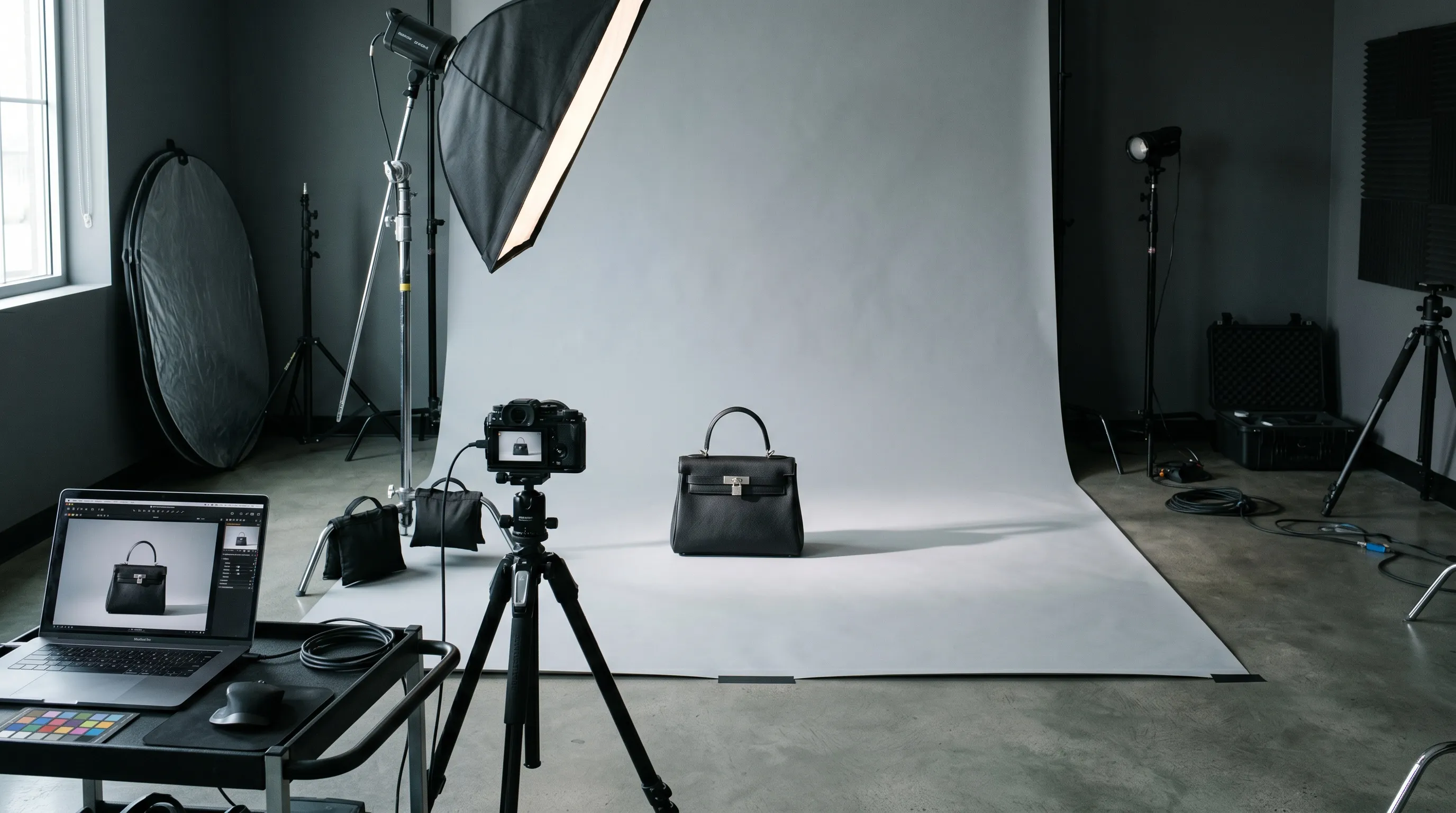
Picture the moment: the invoice arrives, the deliverables folder is opened, twenty hero files sit inside. In this illustrative brief, $10,000 divided by 20 approved images is $500 per master image. That is before anyone prepares the channel exports. It is an expensive outcome if the brand needed a complete catalog, and a reasonable one if the job was twenty carefully art-directed campaign photographs.
That distinction is the problem this essay sets out to name. A hero shoot and a catalog production system are different purchases. A brand can buy excellent photography and still lack the detail views, variants, lifestyle scenes, and channel layouts it needs. Our real cost breakdown separates the production bill from the work needed to turn it into a usable set.
The cost is not vendor greed. Photography is a labor-intensive trade with a real cost floor. The failure is using the same expensive production method for every visual job, then treating the resulting bill as inevitable. Product photography is broken when the workflow fits the campaign but not the recurring catalog.
The Math Behind Why Product Photography Is Broken
There is no fixed number of finished photographs a studio produces per day. Simple packshots, on-model fashion, and a liquid-pour hero have different capture and retouching requirements. A channel export is also not necessarily a new photograph: one well-planned master may support a PDP, an email, and several crops.
Current published prices make that range visible. Soona's Studio pass lists $149 per booking plus $39 per photo before extras. ProShot Media lists general product photos at $15 plus $100 setup, and lifestyle photos at $19 plus $139 per scene. Those are not equivalent to a bespoke campaign with talent and extensive art direction, but they rule out treating $500 as the unavoidable price of every product image.
Here is the arithmetic for three explicitly different briefs:
| Brief | Base cost | Delivered masters | Cost per master | Scope |
|---|---|---|---|---|
| Soona Studio pass, 20 photos | $149 + 20 × $39 = $929 | 20 | $46.45 | Published base; shipping, styling, models, premium edits, and tax may add cost |
| Illustrative mid-market shoot | $5,000 | 40 | $125 | Hypothetical all-in quote; verify what it includes |
| Illustrative hero production | $10,000 | 20 | $500 | The headline case, not an industry average |
Overhead belongs in the calculation, but not as an automatic multiplier. If the hero production also needs 20 internal coordination/review hours valued at $50 and $500 of shipping, its total becomes $11,500, or $575 per master. These are stated assumptions. They do not establish a universal rule that the vendor invoice is only 40% of the true bill.
Now hold that supply against the actual brief. Use the per-SKU planning matrix to separate original captures from adaptations and exports. Twenty hero masters might cover several products and many deliveries; they might still provide none of the rear views or material close-ups a buyer needs. The mismatch is coverage, not a mandatory eighteen-to-twenty-five new photographs for every SKU.
Why Is Product Photography So Expensive? The Six Recurring Costs
The per-image price is the visible part of the bill. Changes in product, format, season, or brief can create additional work. Six recurring costs are worth budgeting: variants, aspect ratios, reshoots, seasonality, rights, and consistency drift. They do not all trigger a new physical session.
The Variant Tax
A new colorway or material finish needs accurate representation. That can mean another sample and capture, but studios can batch variants under one setup. Sizes with the same visible appearance may share an image if the listing remains truthful; different fit or construction may require new evidence.
Consider a four-color t-shirt in five sizes. That is twenty sellable variants, not automatically twenty shoots. Plan which colors need front/back photographs, which sizes change the fit story, and which layouts can reuse those sources. A hypothetical $3,000 separate shoot for each color would total $12,000, but a consolidated session may have very different economics. Get both scopes quoted before using the larger number as the comparison.
The Aspect-Ratio Tax
A square master can be awkward in a tall placement. Filling a 9:16 frame may crop a wide product's sides; fitting the square instead leaves extra room above and below. Neither outcome automatically demands a reshoot.
Sometimes an ordinary crop works. Sometimes the source needs more room, an extended background, or a different composition. Plan the destination before capture and budget each kind of work separately. The per-SKU guide helps map PDP, marketplace, feed, vertical, banner, and email needs without billing each export as a new master.
The Reshoot Tax
Wrong packaging, a missed detail, or a rejected styling choice can reopen a finished job. The cost depends on whether the studio still has the product and set, whether the error falls within its revision policy, and whether new talent or shipping is needed.
Ask what counts as a correction versus a new brief. Then reserve a stated contingency. For example, two hypothetical $1,000 rework sessions add $2,000 to an annual budget; that is a planning case, not evidence that a fixed share of all shoots fail. A shot list and on-set approval can prevent some rework, while a later packaging change is a genuinely new requirement.
The Seasonality Tax
A campaign cannot use imagery that arrives after the promotional window. The schedule includes sample readiness, transport, booking, capture, review, and delivery—not just time behind the camera.
Published schedules are vendor-specific. ProShot Media states a standard turnaround of seven business days after it receives the materials. A larger campaign can need earlier planning, but that is not a universal six-to-eight-week delay. Work backward from launch and agree the actual handoff dates.
Reusable sources and approved visual direction help when only the seasonal setting changes. They do not solve a missing sample or prove what a redesigned package looks like.
The Rights Tax
Licensing may restrict channels, territory, duration, or use of a person's likeness. It can also be perpetual. Read the actual photographer, talent, and location agreements rather than assuming every license expires or every reuse needs a renewal.
This is not unique to commissioned photography. Adobe Stock's license summary, for example, describes perpetual worldwide licenses while distinguishing standard, extended, and editorial-only uses. AI outputs also remain subject to the tool's terms and the rights in any supplied material. A different production method does not remove rights review.
The Consistency Drift Tax
Two shoots six months apart can differ in light, angle, shadow, or color treatment. The catalog looks patched together even if both sessions are technically good.
A physical studio can control this with a documented setup, reference frames, calibrated capture, and consistent retouching. A generative workflow can retain the direction in reusable settings. Both still need comparison against the existing grid. The practical issue is whether the team can reproduce the look without reconstructing the brief from memory; our refresh guide follows that problem through a catalog update.
The Single-Shoot Fallacy: What This Costs Across a Year
The annual budget is a sequence of briefs, not one day rate multiplied by SKU count. Separate the initial product evidence, new arrivals, changed packaging, seasonal scenes, and channel adaptations.
For an illustrative 200-product refresh, six genuinely new approved masters per product means 1,200 masters. At an assumed $50–$150 each, capture and finishing would total $60,000–$180,000 before anything explicitly excluded. If half the required files can instead come from suitable existing masters, the new-capture requirement changes. Do not charge for the entire 1,200 again as both photography and derivatives.
A 500-product catalog with six new masters per product would require 3,000 masters. At a hypothetical negotiated $40 each, that is $120,000; add $10,000 of separately budgeted logistics and internal labor and the total is $130,000. Neither example is a measured industry average. Use the cost breakdown and refresh guide with your actual quote and retained-image count.
Large studios can serve catalogs with thousands of products. The issue is not that physical photography becomes categorically impossible at 5,000 SKUs. It is that a high-touch hero process becomes an expensive default for simpler recurring jobs.
Why Nobody Has Fixed This Before
Physical setup is a real cost floor. The product must arrive, samples must be unboxed, lights must be placed, the stylist must compose, the photographer must expose and review, and the retoucher must finish. Batching and standardization spread that work across more output, but do not make it disappear.
The demand side has several dimensions. More channels create different layouts. More visible variants create additional accuracy obligations. More frequent campaigns create new deadlines. Those dimensions can compound, but not every combination requires new capture.
The answer is partly better production planning and partly a different method for suitable jobs. Capture once where the image must document the real object. Reuse, crop, composite, or generate an adaptation where the needed change is the scene or layout. That is a more useful distinction than declaring the studio obsolete.
What Traditional Photography Still Does Better Than Anything Else
Traditional product photography is especially valuable for hero campaigns with named talent, regulated and trust-sensitive categories, reflective or refractive materials, and any image where the point is the actual photograph of the actual thing.
Hero campaigns with named talent are the clearest case. When the talent is the story—a celebrity, a brand-defining model, a specific human moment—the real person's participation is part of the asset.
Trust-sensitive categories need defensible product evidence. A generated supplement label, food portion, or material close-up cannot establish facts the source did not show. Reflective, transparent, and liquid products also demand careful review of edges, refraction, and contents; real capture is often the safer path. See our iPhone vs AI comparison.
The first accurate visual record of a new physical product has to come from reliable evidence. A generator can invent a concept, but that is not a photograph proving what the shipped item looks like. Founder content, real unboxing, behind-the-scenes, and customer moments belong here too: realness is the format.
Levi's offers a useful counter-case. Its March 2023 announcement and clarification said the AI-model pilot should not have been presented as a diversity initiative and that it was not reducing plans for live shoots or models. Representation and authentic human participation are separate questions from whether a generated garment image looks convincing.
What Changes When the Cost Curve Flattens
For suitable scene and layout work, generation lowers the cost of making another candidate. It can make more experimentation practical, while source capture, direction, review, and delivery still scale with the work.
Klarna is a process case, not a small-store savings benchmark. In a May 2024 interview, CMO David Sandstrom described AI-assisted ideation and creation, while stressing the continued work of designers, creative directors, and post-production teams. He also described an AI sketch leading to a physical shoot. The reported company-wide savings cover a broad marketing process, not just replacement of product photographs.
Mango is the campaign case. Its July 2024 Sunset Dream announcement described a Teen campaign for a collection available in 95 markets. The process began with real photos of each garment, followed by model training, generated imagery, and art-team selection, retouching, editing, and mastering. That is a connected production process, not one-click delivery.
Research provides a narrower performance signal. Hartmann, Exner, and Domdey's author-posted 2024 study tested seven AI banner images against a selected professional stock image across 173,022 impressions. The best AI treatment achieved 0.80% CTR versus 0.53% for the stock treatment in the same campaign; several AI treatments performed worse than stock. These are ad-click results, not proof of product fidelity, listing conversion, or Nightjar performance.
Nightjar is a practical choice when the recurring cost is rebuilding the same photography direction for new products. Saved Products retain real photos and facts. A Photography Style retains the camera, lighting, color, and mood brief. Product-only Framing or model Pose/Camera Distance controls the arrangement, and a Recipe retains those applicable choices, background, and output settings separately from the next Product.
That separation earns its place in a repeated catalog workflow: select the new Product, apply the approved Recipe, change the seasonal background or supported ratio, and review the new result against the actual item. The retained direction reduces rebriefing without promising pixel-locked fidelity. A simple crop or cutout may be better when no new scene is needed; a commissioned shoot remains better for the evidence-critical cases above.
Nightjar's Studio plan is $25/month for 150 Credits. A completed 1K or 2K single image uses 1 Credit, while a 4K result uses 2. That is a candidate-generation allowance, not 150 approved catalog files. The operational comparison must include the full subscription, source preparation, rejected candidates, edits, and review. The longer method is The AI Product Photography Workflow.
The Question Is Not Whether to Keep Paying the Bill
The question is not whether to keep paying for traditional photography. It is whether every new visual requirement deserves another high-touch production brief.
The $500 master in our headline is justified when that is the asset the business needs. It is a poor default when the remaining work is a seasonal setting, a repeatable scene, or a channel adaptation that can build on reliable existing sources.
For the operator who wants to act on this, the methodology lives in our refresh-outdated-catalog guide, and the calculation framework lives in Product Photography ROI. The End of Stock Photos is the companion industry-critique read.
The shoot still has a place. The catalog does not need every change to start with one.
References
- Nightjar cost breakdown — Planning framework, not primary industry data
- Per-SKU planning — Coverage and channel matrix
- Soona pricing — Published booking and photo prices
- ProShot Media pricing — Scope-specific photo prices and turnaround
- Adobe Stock license terms — Perpetual licenses and usage restrictions
- Klarna CMO interview — First-hand process account
- Mango Sunset Dream announcement — Source capture and human finishing
- Levi's announcement and clarification — Human participation and representation
- Hartmann, Exner, and Domdey, author manuscript — Bounded banner-ad evidence