
How can I visualize my furniture or home decor products in a real room using AI?
4 min read
Quick Answer
Use AI product photography to create a new room around the product, or use multi-image product placement when you already have a photo of the room. Supply clear product views and real dimensions, then review scale, perspective, edges, occlusion, shadows, and reflections before publishing. A generated room scene can illustrate styling and approximate scale, but it cannot prove that furniture will fit a measured space.
Which AI workflow should I use for a furniture room visualization?
Create a new room when you need a styled environment; use Product Placement when the room photograph itself must guide the edit:
| Goal | Nightjar path | Best input |
|---|---|---|
| Create a new lifestyle room | Product Photography in the Create tab | A reusable Product with several Product Photos, factual details, and physical dimensions |
| Place the item in a particular room photo | Product Placement in the Edit tab | One clear product image plus the room image |
| Use one room as a recurring scene reference | Product Photography with the room saved as a Location | An empty room photo with visible floor, walls, and lighting cues |
Nightjar calls its reusable product record a Product: it groups the source photos, factual description, and optional Product Dimensions, meaning real-world measurements rather than pixel size. In Product Photography, choose a Location, an image-backed environment used as the setting, and Framing, the product-only camera angle and staging control. A Photography Style can preserve the lighting and photographic feel across a catalog. If you want four related variations, Photoshoot is an output choice inside Product Photography, not a separate Workflow.
For a specific room, add the product and room images to the Edit board, then choose Product Placement. This Edit Shortcut pre-fills a two-image instruction with an explicit product role and scene role. Refine it with the intended position and orientation, such as “place the rug under the front two sofa legs” or “put the lamp on the left side of the console, viewed at the room’s existing camera angle.”
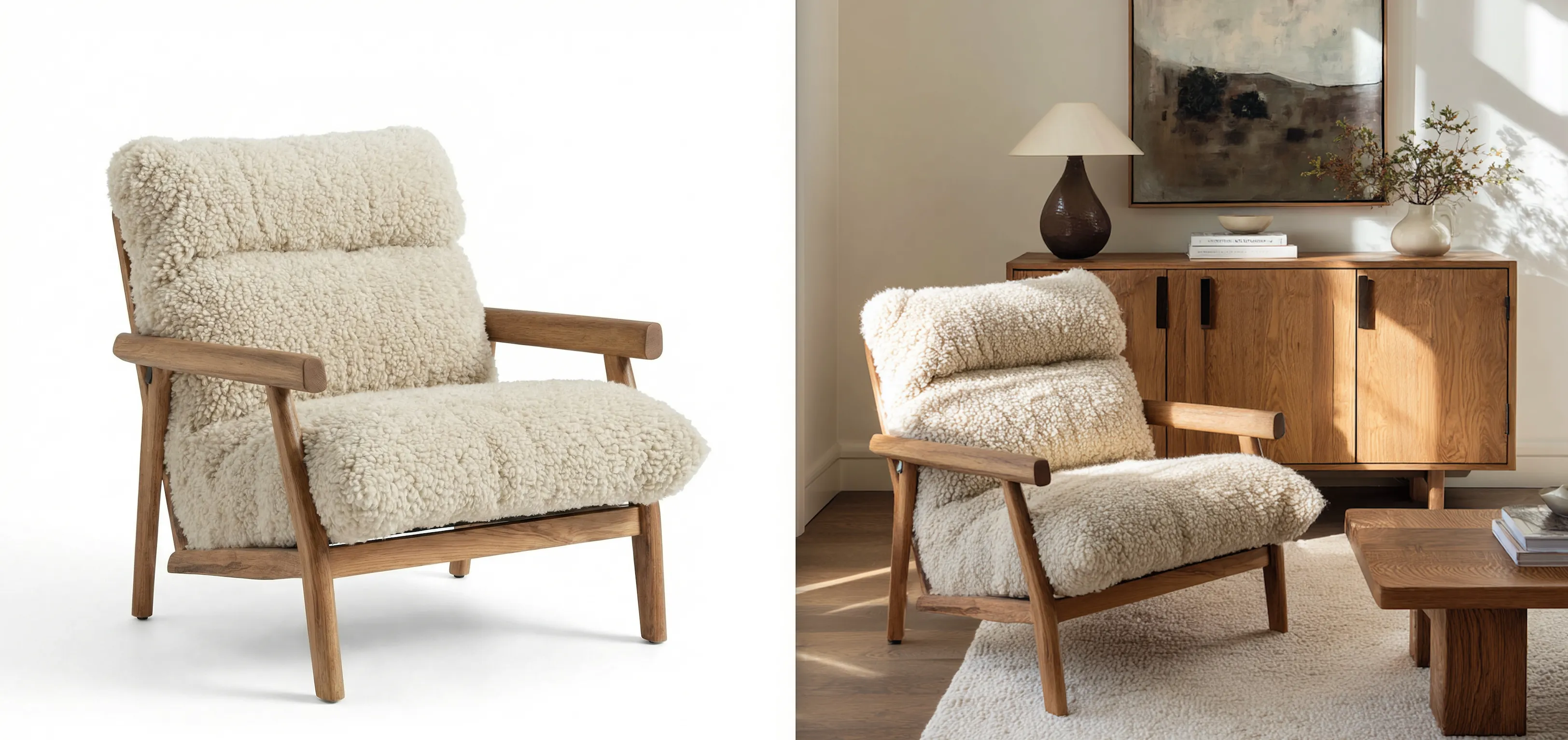
What source images help AI preserve furniture scale and perspective?
AI has better evidence when the product source set includes a front or three-quarter view, a side view, and detail views of identity-defining materials, hardware, seams, or patterns. Keep the full silhouette and every floor-contact point visible. For the room, use a sharp photo with a level horizon, readable vanishing lines, visible floor and wall junctions, and familiar objects that provide scale cues.
Enter the product’s physical width, height, and depth when available. Those measurements help guide relative size, but a single room photograph does not provide a complete measured 3D model. If clearance around a door, walkway, alcove, or other furniture matters, measure that space separately and provide a floor plan or dimension diagram alongside the visualization. A familiar doorway or sofa is only an approximate scale cue unless its dimensions and position are known. Baymard’s furniture research supports showing measurements on the product image so buyers can connect each number to the relevant part.
How should I review an AI-staged furniture image before publishing it?
Review the finished image at full size, not only as a thumbnail:
- Scale and perspective: compare the item with known room features; check that its edges converge toward the same vanishing points as the room.
- Product identity: compare the silhouette, legs, arms, joinery, fabric pattern, wood grain, hardware, text, and logos with the source photos.
- Contact and occlusion: check that feet meet the floor, rugs pass under the intended legs, and foreground objects cover the correct parts without merged edges.
- Light, shadows, and reflections: match direction, softness, color temperature, contact shadows, and reflections in glass, mirrors, metal, or polished floors.
- Room use: verify doors, drawers, walkways, and seating clearances against real measurements rather than the generated image.
Nightjar’s built-in visual review can retry obvious eligible failures at no extra Credit cost. Human review is still required for exact dimensions, finish, structural details, and room fit.
When should I use real photography or manual compositing instead of AI?
Use real photography to document construction, upholstery detail or material finish. Fit and clearance require verified measurements of both the furniture and the space; use a measured plan or dimensionally verified 3D/CAD when illustrating that relationship. Use a manual composite when the photographed product must remain the approved source and a retoucher should control masking, perspective transforms, occlusion, shadows, and reflections directly. Compositing preserves visual evidence but does not independently establish fit.
Treat an AI room image as staged visualization, not measurement evidence. Keep factual dimensions and clearance information beside it, preserve the original product photos in the gallery, and label AI-generated or digitally staged imagery when the applicable law or sales channel requires it. In the United States, the FTC’s advertising guidance requires advertising claims to be truthful, non-deceptive, and evidence-based.
Consistent and on brand AI photoshoots, optimized for conversion.
Nightjar