
Quick Answer
There is no universal conversion winner between a flat lay and a hero shot. Use a hero shot first when shoppers need to judge depth, shape, fit, scale, or material; use a flat lay first when an overhead view explains the product, set, or arrangement fastest. Most product galleries benefit from both formats in different positions, with the first image validated through a controlled test rather than a category-wide assumption.
What is the difference between a flat lay and a hero shot?
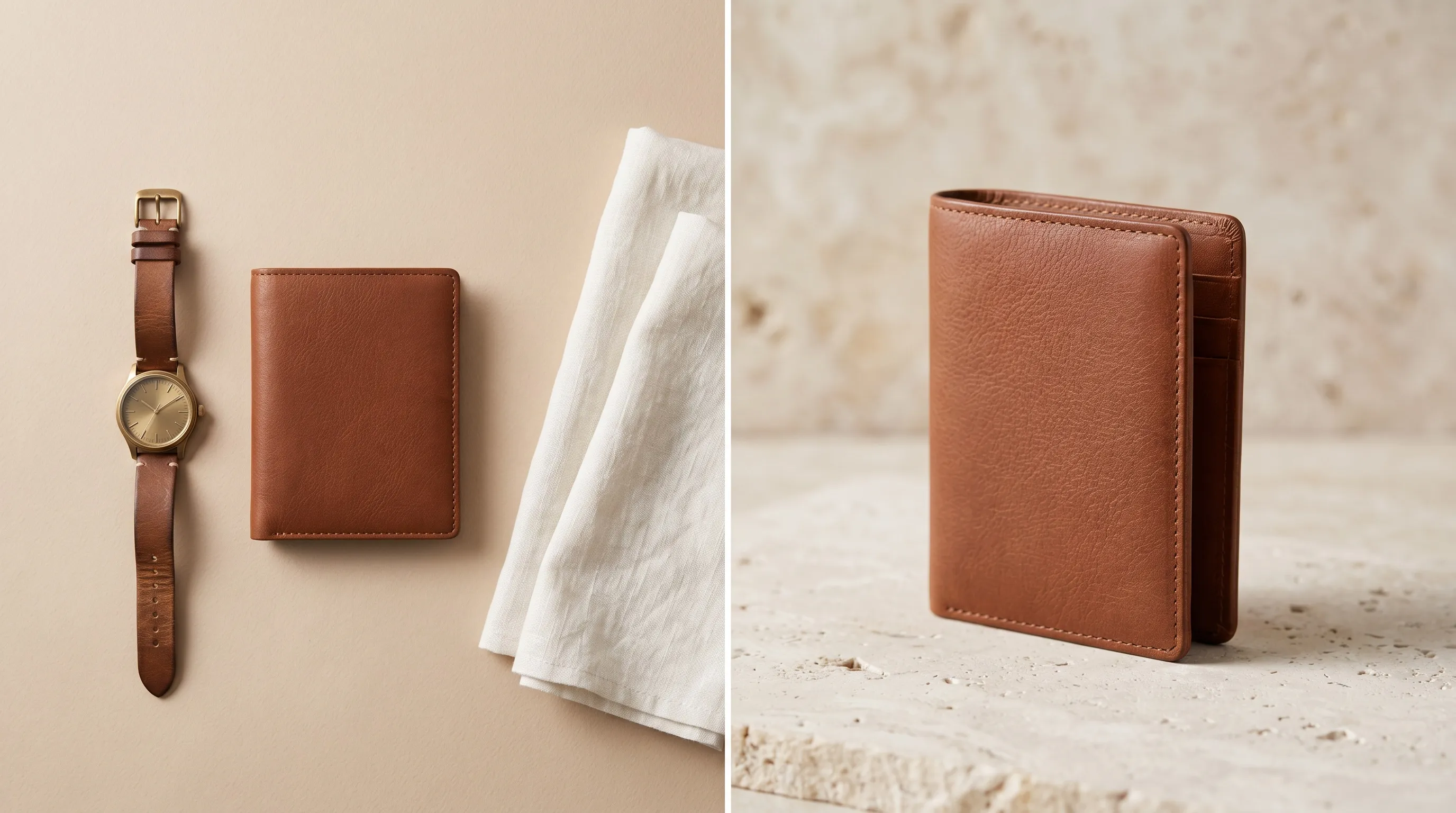
A flat lay describes a camera angle; a hero shot describes an image's job. A flat lay is photographed from directly overhead, with the subject arranged on a surface. A hero shot is the primary image meant to communicate the product at a glance, and it may be front-facing, three-quarter, eye-level, on-model, or even overhead when top-down is the clearest view.
That distinction prevents a common mistake: treating flat lay and lifestyle photography as opposites. A flat lay can be a styled lifestyle scene, while a hero shot can be a clean product-only image on white.
| Format | Information it communicates well | Information it can hide |
|---|---|---|
| Flat lay | Silhouette, item count, color range, component layout, surface graphics | Depth, side profile, drape, height, volume |
| Product-only hero | Shape, volume, finish, construction, one clear product identity | Scale in use, fit, broader context |
| On-model or in-context hero | Fit, scale, use, proportion, emotional context | Small details unless the crop is close |
The useful question is therefore not "which format is better?" It is "which view answers the most important buyer question in this placement?"
Which product image should appear first on a product page?
The first product image should identify the offer quickly at thumbnail size and answer the biggest source of uncertainty. For a single three-dimensional item, that is usually a clean hero view. For stationery, art prints, rugs, kits, bundles, and products whose top surface carries the important information, a flat lay can be the better lead image.
The first position matters beyond the product page. Shopify's product-media documentation says the first media item becomes the main item shown on collection, cart, checkout, and home pages. Etsy's seller guidance makes the role equally plain: the first image earns the click, while later images help earn the sale.
Baymard's product-page testing found that users treat product imagery as a substitute for physical inspection. One participant described the gallery as "sort of a substitute to seeing [the product] in person." That is why a gallery should answer several visual questions instead of repeating one attractive angle. For a deeper treatment of gallery depth, see how many product photos a SKU needs.
| Gallery position | Best default | Question the image should answer |
|---|---|---|
| First image | The clearest hero view, or a flat lay when overhead is the clearest view | What exactly is for sale? |
| Second image | A meaningfully different view | What did the first image hide? |
| Middle images | Detail, scale, on-model, in-use, or component views | How large is it, how does it fit, and what is it made from? |
| Later images | Packaging, variants, instructions, or complete set layouts | What arrives, and how does it work in context? |
This is a decision map, not a rigid slot count. Gallery size and order should follow the product's real evaluation questions and the storefront's display behavior.
Which product categories usually need a hero shot or a flat lay first?
Category changes the default because different products carry their buying information on different surfaces. A three-quarter hero is a sensible first test for a rigid product with meaningful depth. An overhead flat lay is a sensible first test when outline, printed surface, item count, or arrangement tells the story.
| Product category | Sensible first-image test | Where the other format helps |
|---|---|---|
| Apparel | On-model, ghost-mannequin, or shaped hero for fit and drape | Flat lay for fabric, print, embroidery, or the full garment outline |
| Footwear | Three-quarter hero for toe shape, sole, and profile | Flat lay for included accessories or a coordinated set |
| Jewelry and watches | On-body or close hero for scale and light behavior | Flat lay for a collection, pair, gift set, or styling combination |
| Beauty and skincare | Upright or three-quarter hero for packaging shape and label | Flat lay for a routine, kit, shade range, or included components |
| Food and beverage | Package or plated hero for volume and appetite appeal | Flat lay for a spread, gift box, ingredients, or multipack |
| Furniture and home goods | In-context hero for scale and use | Flat lay for rugs, textiles, table settings, or top-surface detail |
| Electronics | Front or three-quarter hero for form factor | Flat lay for ports, accessories, cables, or box contents |
| Stationery, prints, and paper goods | Flat lay when the face of the product is the product | Angled hero for thickness, finish, binding, or packaging |
The matrix should generate a hypothesis, not a universal rule. A rigid gift box and a soft apparel bundle may sit in different rows even when the merchant groups both under "accessories."
When can a flat lay reduce product-page conversion?
A flat lay can hurt conversion when it removes information the shopper needs to trust the purchase. The problem is not the overhead aesthetic itself. The problem is missing evidence.
- Depth and construction disappear. Bags, shoes, furniture, bottles, and electronics often need a side or three-quarter view to show volume, openings, hardware, or thickness.
- Fit and scale become abstract. Apparel, jewelry, eyewear, and furniture benefit from a body or environmental reference when dimensions alone are hard to picture.
- Materials lose their physical behavior. Gloss, transparency, texture, reflection, and edge detail may read more clearly from a lower angle or a closer crop.
- The offer becomes ambiguous. Props can look like included items, while a sparse flat lay can make a bundle look incomplete. The image should make the purchased quantity unambiguous.
- The thumbnail becomes busy. A broad arrangement that works at full size may collapse into small, indistinct shapes on a collection grid or search page.
A useful review test is to shrink the candidate first image to the size used in the real collection grid. If a new shopper cannot identify the product, quantity, and defining feature without zooming, the image is carrying too much context and too little product.
When does a flat lay deserve the first image?
A flat lay deserves the first image when the overhead view communicates the offer faster than an angled view. This is common when the product is essentially planar, the set arrangement is part of the value, or buyers need to compare several included items at once.
Strong flat-lay candidates include stationery suites, art prints, rugs, fabric patterns, cosmetic kits, tool sets, subscription boxes, color ranges, food spreads, and any bundle whose item count matters. A flat lay also works well as a secondary image when the hero view establishes form but cannot show all components together.
The deciding test is informational density, not production convenience. Use flat lay because it reveals something, not simply because it is easier to shoot.
How do Amazon, Shopify, and Etsy rules affect the choice?
Marketplace rules determine what may appear in the first image, but they do not create one universal camera angle. Check the current rules for the product category and country before publishing.
Amazon. Amazon's official product-photo guidance says to use a pure white background in most cases, show the actual product, avoid distracting extras, and let the product fill at least 85% of the frame. A flat lay is not automatically disallowed. It can work when the actual product is clear, fills the frame, and meets the relevant category guide. Amazon's Seller University image guide also gives category-specific examples: shoes at a 45-degree angle, adult clothing on-model, and children's clothing photographed flat. Sellers should use the current Seller Central style guide for their category rather than applying a generic flat-lay rule.
Shopify. Shopify does not prescribe a flat lay or hero angle. Its product-media guidance recommends high-quality media and a consistent aspect ratio for featured images shown side by side. Choose the lead view that reads clearly across the theme's product page, collection grid, cart, checkout, and home placements.
Etsy. Etsy's current listing instructions allow up to 20 photos and two videos per listing. Use that space for a complementary sequence: lead with the clearest offer, then add the opposite view, scale, detail, and context rather than repeating near-identical frames.
How can you make flat lays and hero shots look like one shoot?
Flat lays and hero shots look connected when they share the same photographic language while changing only the information each view must show. Keep lighting character, color treatment, surface family, aspect ratio, and retouching standard stable; change angle and staging deliberately.
Nightjar's Product Photography Workflow gives those decisions separate controls. Save the item as a Product, Nightjar's reusable subject built from one or more Product Photos, so the same product identity guides every view. For product-only shots, use Overhead Framing for the flat lay and Eye-level or Three-quarter Framing for the hero; Framing is Nightjar's fixed control for product-only camera angle, staging, and crop. Use Shadow only for a product-only shot on a flat-color background. Model shots use Pose, Camera Distance, and Background instead of Framing and Shadow.
The shared look belongs in a reusable Photography Style, which preserves camera feel, lighting, mood, color, and texture. A Recipe saves that Create-form direction and output setup without saving the Product itself. In short: Products remember what you are photographing. Recipes remember how you photograph it. A brand can save one hero Recipe and one flat-lay Recipe, reuse the same Product and Photography Style in both, and apply the pair to the next Product without rebuilding the direction. The guide to reusable Photography Styles and the Help Desk's catalog-background consistency workflow cover those controls in more depth.
Choose Photoshoot inside Product Photography when you want four varied but connected images from one direction. Photoshoot changes angle, crop, pose, and detail across the set, so it is useful for cohesive exploration rather than an exact flat-lay-plus-hero shot list.
How should you test flat lay against a hero shot?
Test flat lay against a hero shot by changing one placement at a time and measuring the behavior that placement can influence. The first image affects discovery as well as product-page evaluation, while a secondary-image test mainly affects shoppers who already opened the product.
- Pick one representative product or a tightly matched SKU group.
- Build two images with the same product, crop footprint, aspect ratio, background policy, and general photographic treatment. Change the viewing angle and staging, not every creative variable at once.
- Test the first image separately from the gallery sequence.
- Track collection or search click-through, add-to-cart rate, purchase conversion, and product-related support or return signals where the sample is large enough.
- Keep the winner only for the tested category and placement, then repeat for a different product type.
Eligible Amazon brands can use Manage Your Experiments to test product images and compare conversion, sales, units sold, and sample size. Amazon recommends letting experiments run until the result is statistically significant. On other storefronts, use a testing system that splits traffic consistently and avoids changing price, promotion, copy, or availability during the image test.
Frequently Asked Questions
Is a flat lay the same as a white-background product photo? No. Flat lay describes an overhead camera position. A white-background photo describes the background, so it can be overhead, front-facing, or three-quarter.
Is a hero shot always a lifestyle image? No. A hero shot is the lead image that communicates the product most clearly. It can be a clean studio image, an on-model image, a lifestyle scene, or an overhead flat lay.
Can AI turn an angled product photo into a flat lay? AI can generate a plausible overhead view, but surfaces hidden from the camera must be inferred. The Help Desk explains when to generate, correct perspective, composite, or reshoot an AI flat lay.
Which Nightjar control creates a flat lay? For a product-only Generation, choose Overhead Framing in Product Photography. For other angle changes and their fidelity limits, see how to change a product photo's camera angle with AI.
Should I use Photoshoot to create one flat lay and one hero shot? Use Photoshoot when you want a cohesive four-image set with useful variation. Use separate Single shots when exact Framing choices and a prescribed gallery sequence matter.
How many product images should a product page include? Use enough images to answer the real buyer questions about identity, fit, scale, material, details, contents, and use. The answer varies by category, and the product-gallery image-count guide provides a practical framework.
References
- Amazon product photography guide - Official general guidance on product presentation, angles, background, and frame fill
- Amazon Seller University image guide - Official main-image requirements and category examples
- Amazon Manage Your Experiments - Official image-testing workflow and reported metrics
- Shopify product-media documentation - Main-media placement and gallery ordering
- Shopify product-media types - Image quality, resolution, and aspect-ratio guidance
- Etsy guidance for listings that convert - First-image role and listing-photo guidance
- Baymard Institute on product-gallery thumbnails - Original usability research on how shoppers use product imagery