Quick Answer
Midjourney can create and edit polished product concepts, use up to four reference images, reuse a visual style, and produce 2K output. A dedicated AI product photography tool is the better primary system for a commercial catalog because it keeps the real product, reusable shoot direction, review, team access, and automation in one workflow rather than rebuilding those decisions for each prompt.
Midjourney is a creative system, not a catalog system
Midjourney is good for product-photo concepting, campaign exploration, and individual creative images, but it is not designed as an end-to-end product catalog system. The current default model is Midjourney V8.2, released as the default in July 2026, with stronger image quality, Personalization, and a new Edit Model.
That Edit Model closes several gaps described in older comparisons. It can modify an existing image from written instructions, generate a new composition from up to four reference images, change perspective, and work with inpainting and outpainting in the web Editor. Midjourney also offers Style References, Moodboards, seed locking for controlled experiments, and Draft Mode for rapid visual exploration.
Those are real production aids. They do not, however, turn Midjourney into a durable record of what a brand sells or how every product should be photographed. Each new catalog request still needs the right references, prompt, style controls, and review decisions assembled around it. That difference becomes expensive in attention long before it becomes expensive in subscription fees.
What does Midjourney do especially well for product images?
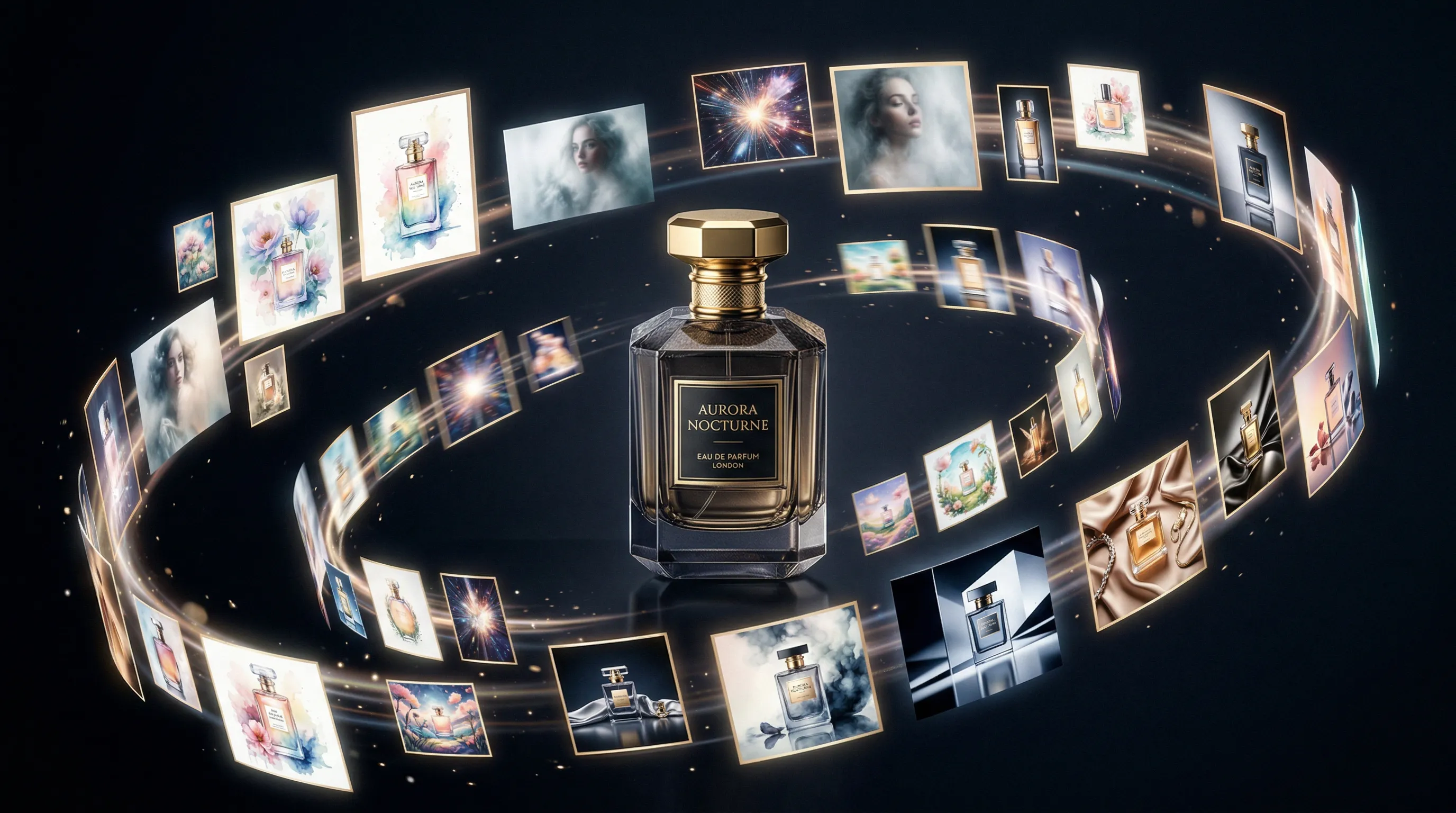
Midjourney is strongest when the brief rewards visual exploration more than repeatable catalog operations. Style References capture colors, lighting, texture, and other visual traits from one or more images; Moodboards express a broader aesthetic from a collection; and Draft Mode in V8.2 produces a 24-image batch of low-resolution concepts. Those controls make Midjourney useful for finding a campaign world before a brand commits to production.
Good Midjourney product-photo jobs include:
- exploring campaign concepts and mood boards
- testing an art direction before a physical or AI photoshoot
- creating a one-off editorial or social image
- extending, retexturing, or selectively editing an existing concept
- trying several perspectives when exact catalog repeatability is not the main constraint
Midjourney is also easier to use than its old Discord-only reputation suggests. The website supports creation, organization, plain-language conversational prompting, and a visual Editor with masking, layers, custom aspect ratios, and exports. A current comparison should judge that product, not the 2024 interface.
Dedicated tools win when the product must persist
Dedicated AI product photography tools have the advantage when the work must represent a real sellable item repeatedly across a catalog. The decisive questions are not whether a model can make one attractive frame, but whether the workflow remembers the product, preserves the brand's production direction, catches visible failures, supports a team, and can connect to the rest of the catalog pipeline.
| Production requirement | Midjourney V8.2 | Nightjar | Photoroom | Pebblely |
|---|---|---|---|---|
| Product reference | Up to four Edit Model references; Image Prompts guide rather than copy exactly | Products group multiple Product Photos, factual description, and physical dimensions | Starts from a product image for Product Staging and AI Backgrounds | Starts from an uploaded product image |
| Reusable visual direction | Style References, Moodboards, Personalization, and reusable style codes | Photography Styles, Backgrounds, Poses, Fashion Models, fixed controls, and Recipes | AI Background references plus batch-consistency settings | Style image, color, prompts, and templates |
| Catalog production | Manual prompts, permutations, folders, and review | Shared Products, Recipes, Team Library, and Product Photography Workflow | Batch Mode and Shopify product-catalog workflows | Bulk generation for multiple products |
| Automated workflow | No general public API; unauthorized automation is prohibited | Public REST API included with every active paid Subscription | Paid API with separate API pricing | Bulk generation in the app |
| Output size | V8.2 SD starts at 1024px square; HD or upscale reaches 2048px square at 1:1 | 1K, 2K, or 4K where supported; Upscale targets 2K or 4K | High-resolution export on paid plans | Multiple social size presets |
| Current entry model | $10 to $120 monthly plans, metered by GPU time | Subscription with Team Credits; plans start at 150 Credits per month and scale up | Free personal-use tier; paid plans add commercial use, AI features, and Batch Mode | $19 for 200 images or $39 for 500 images per month |
Photoroom and Pebblely illustrate that “dedicated” is not one feature set. Photoroom Batch is a strong fit for removing or changing backgrounds across many existing product images, and its batch-consistency setting can reduce background variation. Pebblely's current workflow is deliberately simple: upload a product, describe the scene, and generate, with bulk creation on paid plans.
Nightjar covers the deeper catalog problem. A Product is a reusable record built from multiple Product Photos plus factual details. A Recipe is a saved Product Photography setup that keeps the Photography Style, Background choice, Framing and Shadow for product-only shots or Pose and Camera Distance for model shots, Custom Directions, and output settings together. Products remember what is being photographed; Recipes remember how it should be photographed. The next item can therefore inherit the same production direction without pretending the product itself is interchangeable.
Can Midjourney preserve an exact product, logo, or label?
Midjourney can use product references, but a generated or edited result still needs close comparison with the real item before publication. Midjourney's own Image Prompts documentation says references are used “as inspiration to guide new creations, not to copy them exactly.” Its text-generation guidance says shorter Latin-alphabet words have a better chance of appearing correctly and recommends Raw, lower Stylize values, or another editing pass when text is wrong.
That distinction matters for packaging, logos, controls, stitching, proportions, and other details a buyer relies on. An image may look persuasive while still depicting the wrong label character or a changed component. Midjourney's Terms also provide the service and assets without warranties of fitness or suitability, so visual plausibility is not product verification.
Nightjar is built to give product fidelity more evidence and another review layer. A Product can store several views, a factual description, and physical dimensions. Built-in visual review compares supported outputs with their references and request, and it can retry obvious eligible substitution, omission, text, brand-mark, or catastrophic failures without another Credit. This reduces avoidable failures; it does not guarantee perfect product reproduction. Exact commercial artwork should still be checked at final size, as explained in the guide to stopping AI from garbling product text and logos.
Catalog memory is the real workflow advantage
A dedicated product photography workflow is better for a repeat catalog because the product identity and shoot decisions persist after the first output. Midjourney can pin references, reuse style codes, run permutations, and organize creations in folders, but its account and prompt system does not provide the same Product-to-Recipe-to-Team relationship.
Consider a brand photographing a mug collection. In Midjourney V8.2, the operator can attach several mug references to the Edit Model, describe a studio treatment, add a Style Reference or Moodboard, request another perspective, and correct areas in the Editor. For the next mug, the operator assembles the appropriate product references and checks whether the style, crop, scale, handle, glaze, and printed artwork still match the brief.
In Nightjar, the operator creates a Product from the mug's approved Product Photos and details. The Product Photography Workflow then separates the decisions: Photography Style controls the photographic feel; a flat background or saved Background controls the setting; Framing and Shadow control product-only staging; aspect ratio, resolution, and format control delivery. The operator can save those decisions as a Recipe, apply it to the next Product, and share the same setup with the Team. For broader guidance, see how to make AI product photos more consistent and how to control AI product-photo camera angles.
Photoshoot handles a different consistency scale. It is a cohesive four-image output choice inside Product Photography that varies angle, crop, pose, and detail within one connected set. Recipes and reusable ingredients carry direction across later Products and Generations. One keeps a set together; the other helps the whole catalog belong to the same brand.
Does Midjourney support an API or batch catalog automation?
Midjourney does not offer a general public API for catalog automation. Its current Community Guidelines say that, apart from rare expressly granted exceptions, it does not provide an API and prohibits automated interaction and unauthorized third-party scripts. Permutation prompts can submit prompt variations more efficiently, but they are a creative prompting feature rather than a product catalog API.
This limitation is decisive when images must be generated from a product-information system, approved in an internal queue, or created as part of an embedded customer feature. Nightjar's public API documentation covers Upload Sessions, Assets, Products, reusable ingredients, and the Product Photography, Edit Images, and Upscale Workflows. Side-effecting requests support idempotency keys, and asynchronous Generations can be polled to completion. Photoroom also offers a paid API for image processing and product-photo workflows.
Automation does not remove human review. It removes repetitive transport and setup work, leaving a person to validate that the finished image represents the product and meets the destination's current rules.
How do pricing, commercial rights, and privacy compare?
Midjourney's sticker price is low for creative exploration, but its commercial and privacy rules deserve the same attention as GPU time. Current Midjourney plans cost $10, $30, $60, or $120 per month before annual discounts. Standard, Pro, and Mega include unlimited image generation in Relax Mode; Stealth Mode is limited to Pro and Mega.
Midjourney says subscribers own the images they create to the fullest extent possible under applicable law, subject to third-party rights and its terms. A company earning more than $1 million in annual gross revenue must use Pro or Mega to own its assets. Midjourney is open by default: creations may appear on its website unless Stealth Mode is used, and content made in a shared Discord space remains visible there. The Terms also grant Midjourney a broad, continuing license to submitted and generated content. Read the current commercial-use explanation, privacy guidance, and Terms before uploading unreleased products or confidential campaign work.
Dedicated tools use different rules. Photoroom's free plan is for personal use, while its paid plans permit commercial use subject to source-image and third-party rights. Nightjar's Terms grant ownership of generated output for lawful commercial use and state that user Input and Output are not used to train or fine-tune AI models unless the user explicitly opts in. No AI vendor's output ownership supplies rights to a third party's trademark, copyrighted image, or likeness.
The decision: Midjourney for exploration, dedicated tools for production
Choose a dedicated AI product photography tool as the primary system when you sell a repeat catalog; choose Midjourney as a creative exploration and concepting tool. That recommendation follows from workflow fit, not a claim that one model wins every image comparison.
Use Midjourney when:
- you are searching for a campaign concept or visual world
- you want fast aesthetic variation from Style References or Moodboards
- one editorial image matters more than repeatable catalog operations
- a human designer will direct, inspect, and finish the output
Use Nightjar when:
- multiple Products must share one recognizable brand direction
- the product needs several reference views and factual context
- a Team needs reusable Photography Styles, Backgrounds, Poses, Fashion Models, and Recipes
- built-in review should catch and retry obvious eligible failures before delivery
- the same product-photography system must work through a browser, Shopify app, or public API
Use Photoroom when the core job is fast background removal, batch background treatment, or mobile-first listing edits. Use Pebblely when a small catalog needs a short upload-describe-generate path and simple bulk scene creation. For a wider field, compare the best AI product photography tools for 2026 or review Midjourney alternatives for product photography.
Frequently Asked Questions
Can Midjourney use a real product photo as a reference? Yes. Midjourney V8.2's Edit Model can work from up to four reference images, and Image Prompts can influence content, composition, and color. Midjourney says Image Prompts guide new creations rather than copy the source exactly, so compare every commercial output with the real product.
Can Midjourney keep the same style across product photos? Midjourney can reuse Style References, style codes, Moodboards, and Personalization profiles. Those controls can keep a visual theme closer, but a catalog still needs repeated product-reference setup and review; a dedicated system also stores the product and the full shoot configuration.
Can Midjourney generate several product angles from one photo? Midjourney's Edit Model can request a changed perspective, so the old answer “not natively” is no longer accurate. A generated angle is still an inference, not proof of hidden product geometry; review it against additional source views or use a controlled workflow for changing product-photo camera angles with AI.
Can Midjourney images be used for ecommerce and advertising? Subscribers generally receive commercial usage rights under Midjourney's Terms, with special Pro-or-Mega requirements for companies above $1 million in annual gross revenue. The user remains responsible for third-party intellectual-property, trademark, privacy, and publicity rights.
Are Midjourney creations private? Midjourney is open by default. Stealth Mode is available only on Pro and Mega plans, and creations made in shared Discord channels remain visible to people in those channels even when Stealth is enabled.
Can Midjourney be automated through an API? Not through a general public API. Midjourney says unauthorized automation and third-party scripts are prohibited except for rare expressly granted exceptions.
Can AI-generated images be used as Amazon main images? The finished file must meet the current rules for its category and accurately represent the item. Review Amazon-specific requirements before publishing, and use the detailed guide to Amazon policy for AI-generated product images.
References
- Midjourney version documentation - V8.2 status and feature compatibility
- Midjourney Edit Model - editing, perspective changes, and reference-image limits
- Midjourney Image Prompts - how source images guide new creations
- Midjourney Style Reference - reusable visual-style controls
- Midjourney Draft and Conversational Modes - rapid concept generation and prompt assistance
- Midjourney upscalers - current V8.2 image dimensions
- Midjourney plans - current prices, GPU allowances, and Stealth availability
- Midjourney Terms of Service - content rights, licenses, and account rules
- Midjourney Community Guidelines - API and automation policy
- Nightjar API documentation - programmatic product-photography resources and Workflows
- Nightjar Terms of Service - output ownership, commercial use, and model-training terms
- Photoroom plan guide - plan scope, Batch Mode, API, and commercial-use limits
- Photoroom AI Backgrounds - reference backgrounds and batch consistency
- Pebblely's 2026 product and pricing update - current workflow, bulk generation, plans, and image allowances